
Juniper, the little brown dog that charmed a whole hospital
Juniper, a three-legged rescue dog, overcame life-threatening health issues at CSU’s Veterinary Teaching Hospital, inspiring her owner to join the team that saved her.


Link copied!
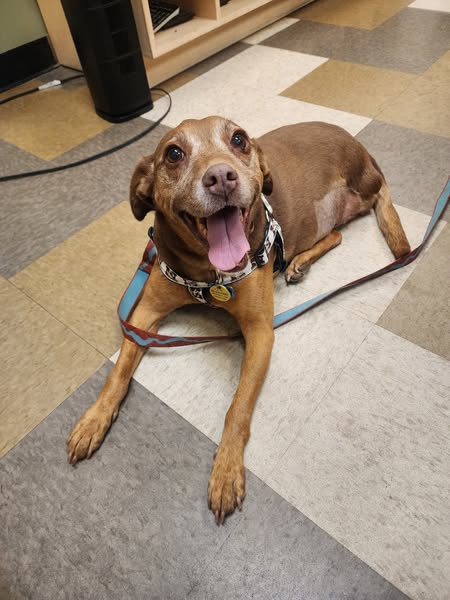
One little three-legged dog embodies all that the CSU Veterinary Teaching Hospital can do for complex medical problems. Juniper is an 11-year-old rescue dog who first came to the Small Animal Emergency and Urgent Care service in November 2022 with fluid build-up in her chest. Little did her owner, Rebekah Flynn, know the visit would mark the start of a journey that twisted and turned throughout the hospital’s many services, leading to a job for Flynn, a deep bond with a new resident, and a positive outcome for Juniper.
Flynn and her husband, Enrique Mejia, call Juniper their “LBD” (Little Brown Dog). They adopted her from Animal Friends Alliance as an anniversary gift nine years ago, and their outdoor life centers around their “adventure dog.” “Juniper is a really strong hiker, she could do 12-mile hikes with thousands of feet of elevation,” Flynn said. “Juniper is our best friend. She’s our only pet and she is so, so meaningful to my husband and me.”
CSU emergency veterinarians stabilized Juniper and referred her to Small Animal Internal Medicine, where Dr. Rommaneeya Leela-arporn (“Dr. Air”) was just starting her three-year residency. She began to delve into the reasons behind Juniper’s fluid retention and kidney dysfunction. She and the internal medicine team diagnosed Juniper with protein-losing nephropathy (PLN), a kidney condition that causes loss of protein in the urine. Dogs with PLN may develop swelling (edema), increased thirst and urination, lethargy, or weight loss. To manage her condition, the team started medications to reduce protein loss and a blood thinner to help prevent potential blood clots, which can be a complication of this disease.
Despite the medical management, Juniper’s symptoms progressed rapidly, and by December she couldn’t move her back legs.
“It was really scary. She stopped eating, she couldn’t walk anymore,” said Flynn, who raced back to the hospital in the middle of the night. The Small Animal Diagnostic Imaging service did a CT scan and “that night they determined we needed to go in for emergency surgery through the cardiology team to remove all of the blood clots that had formed in both of her legs.”
Cue the clot busters

CSU cardiologist Dr. Brianna Potter was on call that night for the Cardiology service, and assembled teams from Small Animal Anesthesia and Pain Management and Cardiology in the hospital’s cardiac interventional operating room, where doctors use three-dimensional imaging to guide them to the clot’s location.
“By using moving X-rays, we can pass catheters and wires down into the vessels in the legs. Then we use contrast (angiograms) to see the location of the clot,” Potter said. “The angiogram helps us see where to inject a drug that will hopefully help break up the clot. After infusing a clot-busting drug, we then go in with a balloon and try to break up the clot by inflating the balloon in that area.”
Potter suspected the clots had been forming slowly for some time and had become very hard. “Because the clots were so stiff and resistant, just the balloon alone wouldn’t open up the vessels enough. So, then we had to use stents in both legs to push the clots aside and leave her an opening for the blood flow,” she said.
At 2 a.m., after a six-hour surgery, Flynn and Mejia got the call that the operation was successful.
“We felt very lucky throughout this,” for having pet insurance, and for the expert care at CSU. Flynn said “They told us they were able to clear both legs of her blood clots by going in through her neck, which I thought was crazy. She had this big incision in her neck and they somehow got tools down into her back legs. Amazing.”
Relearning the basics in recovery
Juniper spent 10 days recovering in the hospital’s Small Animal Critical Care unit, attended by dedicated veterinary technicians and clinicians who closely monitored her pain level and kidney function. Leela-arporn was by her side most of that time.
“She basically forgot all the things,” said Leela-arporn. “She forgot how to eat. She totally forgot how to walk, so she needed physical therapy.” The Small Animal Rehabilitation and Physical Therapy service worked with Juniper on mobility, and taught Leela-arporn to do the exercises so that she could work with Juniper over the weekends and evenings.
“Basically, I did all the things with her. So that’s how we bonded. She wouldn’t eat for anyone, so I started feeding by hand. Then, she started eating, she started walking. Yeah, All The Things.”
Once she relearned the basics, Juniper was able to go home, but she developed a large hematoma at her incision scar on her neck so had to return for an operation with the Small Animal General Surgery service to drain it.
Giving the boot, and the leg, the boot

Because of the lack of blood flow, Juniper had lost feeling in one of her feet, so after she went home from the hospital, she continued to see the rehab service, working on mobility and exercising in CSU’s underwater treadmill. She wore an orthotic boot for several months to help with the nerve damage, but one day, she had enough.
“We came home from work and Juniper had chewed through her foot. She just decided that she did not want it. She just couldn’t feel it,” Flynn said. “We came home to just a pool of blood and her chewing on her foot. It was awful. So we took her to urgent care of course and pretty immediately they said you probably want to amputate.”
Flynn and Mejia were hesitant because Juniper is their hiking buddy, so they opted to treat the wound and try to save the leg. They saw the surgery service three times a week for wound care and bandage changes, but then she developed an infection that spread to the bone and her skin became necrotic. It became a choice between saving her leg or saving her life.
“That was that was the point we’re like, ‘OK, we’re taking, we’re taking the leg.’ It was a hard decision but it was so funny, it was so much harder on me than it was on Juniper. Juniper immediately was like, ‘oh, this is what I wanted the whole time. I tried to tell you.’ So we did the amputation and very quickly realized Juniper doesn’t care.”
She was up and walking the next day. “That transition was really, truly so easy, but we had a couple more bumps along the way,” Flynn said. “It was probably eight months of you would fix something and then that resulted in a different problem, that you fix that problem and it resulted in another problem.”
Experts lean on each other
Juniper was in the right place, though. With 28 specialty services, the CSU Veterinary Teaching Hospital was able to address each challenge.
“I think what’s so special about Juniper’s case is that it’s an example of when specialties are able to come together in a multidisciplinary way,” Potter said. “We can lean on each other’s expertise and have better outcomes for the patients. Dr. Air and the internal medicine team were able to treat her protein-losing nephropathy, and I think that’s why she’s done so well versus if we were never able to find out why she formed those clots.”
“Plus, it’s pretty amazing when you have very dedicated owners invested in searching for an underlying cause. That’s a testament to good long-term chronic care through internal medicine. And then Becky believed in the teams and this place enough to want to work here,” Potter said.
Joining the team
Flynn spent so much time at the hospital that she decided to apply for a job with the hospital front desk.
“Juniper went through so much and I was so distraught for so much of it. The front desk staff was so kind and patient with me, to the point that I asked them, ‘are you guys hiring? I would like to work here,’” said Flynn, who was recently promoted to a position in the hospital pharmacy. “And so eight or 10 months after Juniper was first seen here, I got hired on through the front desk staff. It really impacts the way that I interact with clients because I know exactly what they’re going through.”
Despite having four surgeries and countless hospital visits, Juniper loves her mom’s workplace.
“I don’t want to toot my own horn, but she does feel like a celebrity,” Flynn said “I’ll be talking to people and they know her. Someone in anesthesia told me ‘Juniper was the only patient that made me cry at this hospital.’ I love thinking about her being integral to stories that doctors remember.”
Walking the halls with Juniper is like being part of a celebrity entourage. She’s just a little brown dog with three legs, but “she’s just so ridiculously happy and there’s not a single person that walks by that can’t smile at her. She just has like this infectious smile and personality,” Flynn said.
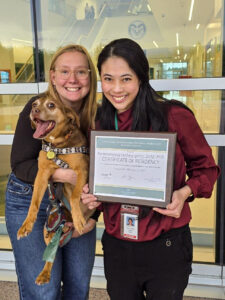
As Leela-arporn’s patient through all three years of her residency, Juniper has a special place in her heart. “She’s basically my baby,” said Leela-arporn, who returned to Thailand after completing her residency this July. She will continue her CSU research and remain a part of the internal medicine team virtually.
Juniper, of course, attended the residency ceremony.
“She just loves Dr. Air so much,” Flynn said. “It’s incredible to me that she has had so many traumatic experiences here but she still has so much trust. She just loves it here.”


Veterinary Health System
Colorado State University’s Veterinary Health System is a community of veterinary professionals dedicated to providing exceptional service with passion and purpose. Our experts are animal and public health leaders working together to apply their diverse skills in veterinary care, diagnostics, and education. As a partner of CSU’s top-ranked academic veterinary program, the clinical team works with researchers and educators to advance the future of veterinary medicine.