Internships and Externships
Veterinary technician internship
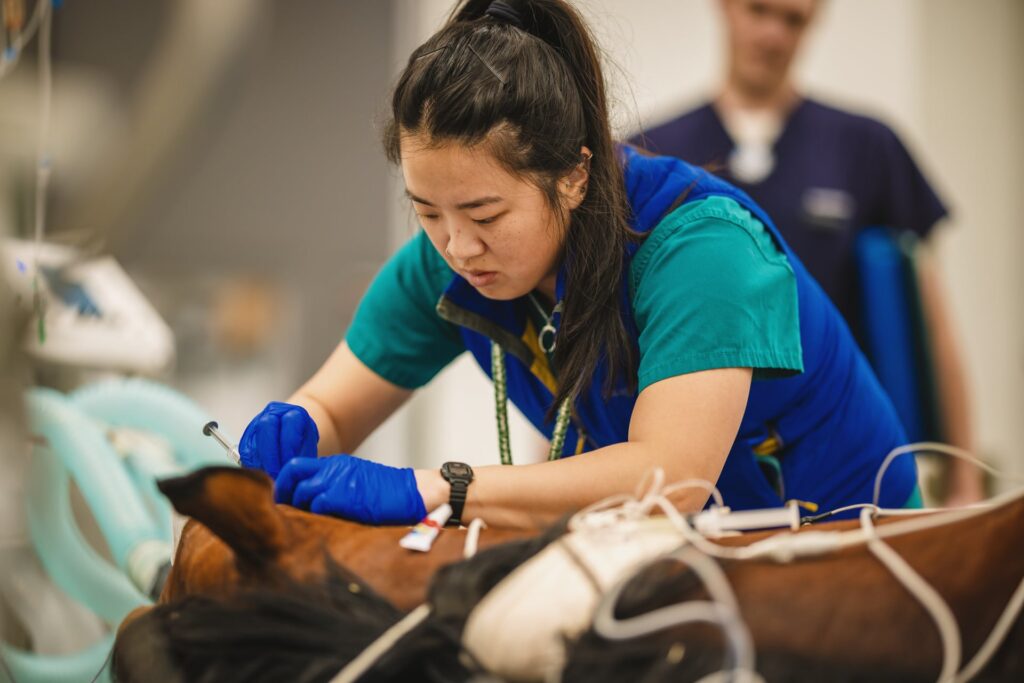
Our program offers you learning opportunities unlike any other. As one of the busiest hospital systems in the Mountain West, you’ll work with a variety of species alongside our experienced professionals.
We can customize your experience to the hours or weeks required by your program. This internship is designed for technician students who have received approval from their educational institution to participate and are nearing completion of their program.
Rotations
*Rotation availability is subject to change based on caseload, staffing, and other teaching obligations.
Small animal track
Core:
- Anesthesia and Pain Care
- Primary Care
- Internal Medicine
- General Surgery
- Central supply (FRCC interns only)
- Dentistry and Oral Surgery
- Dermatology
- Cancer Care
Elective:
- Central supply (Bel Rea only)
- Emergency and Critical Care
- Orthopedic Surgery
- Livestock Veterinary Services
Mixed animal track
Core:
- Anesthesia and Pain Care
- Primary Care
- Cancer Care
- Equine Internal Medicine
- Equine Surgery and Lameness
- Livestock Veterinary Services
- Equine Reproductive Care
Elective:
- Internal Medicine
- General Surgery
- Central supply
- Dentistry and Oral Surgery
- Dermatology
- Emergency and Critical Care
- Orthopedic Surgery
Mentorship program
We’re here to make your veterinary technician internship experience rewarding! Every intern is paired with a mentor from our team based on shared interests. Your mentor is your go-to resource for guidance and support throughout the program – whether you prefer regular check-ins or just occasional advice, they’ll be there when you need them.
Veterinary internships
Internships are one-year, non-degree programs that provide training for practice, clinical teaching, and specialty-board eligibility. Positions are filled through the Veterinary Internship & Residency Matching Program sponsored by the American Association of Veterinary Clinicians.
Prepare for the next step in your veterinary career as a small animal rotating intern at CSU, where you’ll gain hands-on clinical training in emergency and specialty care of dogs, cats, and zoologic companion animals. Fill the role of primary clinician – you’ll be responsible for patient care, medical decisions, owner communication, and student teaching. Our hospital averages 40-60 emergencies (30 percent of our emergencies are zoologic companion animals!), 20-25 hospitalized ICU patients, and 10-25 soft tissue surgical procedures per day.
Most of your year as an intern will be spent in core clinical rotations: emergency medicine, internal medicine, surgery, cardiology, neurology, ophthalmology, and avian, exotic, and zoological medicine. Elective rotations can be tailored to your career goals. Four weeks of off-clinic time are dedicated to research, conference attendance, and vacation (one week).
Take advantage of additional opportunities to learn during lectures, labs, and case discussions led by different faculty:
- Half-day emergency procedures lab hosted by Emergency and Critical Care to ensure you’re comfortable with life-saving procedures from day one
- Two hours of weekly didactic learning throughout the year (you get to choose some of these topics!)
- RECOVER Basic Life Support and Advanced Life Support certification
- Point-of-care ultrasound training
- Bandaging and wound management labs
- Dental and ophthalmic procedure labs
- Communication training
- Specialty-specific journal clubs and resident-level courses
Mentorship and support
You’ll be mentored by a faculty member who is part of the intern selection committee – they will serve as your champion in the hospital, helping you navigate career decisions, transitions into a new clinician role, and troubleshooting any challenges you face. You may also have a faculty research mentor, who will help with data collection, manuscript completion, and presentations at national conferences.
Gain your independence as a veterinarian while getting the support you need – our specialty service residents and faculty are on call 24 hours a day, seven days a week to assist and guide you with case management. Pair up with a resident through the house officer advisory committee to get peer-to-peer support. Plus, pass on your knowledge and hone your teaching skills by working closely with third- and fourth-year veterinary students on clinics.
Additional wellness and support services are available through the Argus Wellness and Support.
Research
While a research project is not required, you are encouraged to become involved with clinical research. Explore research opportunities in all specialty fields, from benchtop to clinical projects. Find a faculty member with a new or ongoing research project, then present your work at a national conference. You’ll have an opportunity at the end of the year to showcase your research and knowledge gained to the entire hospital!
Benefits
Learn more about health insurance benefits and requirements for veterinary licensure via the Veterinary Internship & Residency Matching Program.
Visit the Flint Animal Cancer Center’s specialty training page for more information.
Contact Deb Liptak and Candice Hastings for more information.
Externships
We welcome visiting veterinary students to experience our world-class facilities during clinical years of study.
We welcome visiting veterinary students interested in a clinical rotation at the James L. Voss Veterinary Teaching Hospital. For externship information, including availability*, length of stay, housing, and international questions, contact Krista Pfeiffer.
We will start taking requests for the May 2026-May 2027 period starting March 23, 2026.
*Availability may be limited due to class size. For the 2026-27 period, externships in large animal and equine are available, while small animal rotation opportunities are limited but may include oncology, urgent care, and exotics, depending on the dates.
Please note that, due to capacity constraints, we are unable to accept applicants seeking training opportunities required for certification programs such as the Educational Commission for Foreign Veterinary Graduates (ECFVG), National Examining Board (NEB), Program for the Assessment of Veterinary Education Equivalence (PAVE®), or other certifications for graduates of international, non-accredited veterinary programs.
The two- to three-week anatomic pathology externship takes place at the Veterinary Diagnostic Laboratories, which conducts approximately 1,600 necropsies and 34,000 surgical biopsies each year. Case material comes from the Veterinary Teaching Hospital, private practitioners and individuals, and the National Park Service. The anatomic pathology groups consists of eight board-certified anatomic pathologists and seven pathology residents.
Informal activities include participation in the post-mortem practicum with senior veterinary students and observation of surgical biopsy diagnosis with pathology faculty and residents. Scheduled activities include weekly histology and clinical pathology slide seminar, journal club, surgical pathology class, gross pathology class, and necropsy rounds.
Externs must be vaccinated against rabies. Externships will be filled on a first-come basis and limited to two at a time. Externs are accepted year round, except during the month of July. The summer months are typically in highest demand, so early application is encouraged. Applications must include a curriculum vitae and letter of intent. Scholarship opportunities are available via the American College of Veterinary Pathologists.
Submit applications to:
Dr. Chad Frank
320 Diagnostic Medicine Center
300 West Drake Road
Ft. Collins, CO 80526
[email protected]
(970) 297-5129
The one- to two-week clinical pathology externship takes place at the clinical pathology laboratory, which receives cytology, hematology, and biochemical profile submissions from within the Veterinary Teaching Hospital and veterinary practices across the country, and sees a cytology caseload of approximately 7,500 cases per year. The clinical pathology group consists of seven board-certified clinical pathologists and three clinical pathology residents.
Informal activities involve shadowing the clinical pathologists and residents during daily interpretation of cases, as well as a number of self-guided cytology/hematology teaching sets. Scheduled activities include weekly clinical pathology slide seminars, “topics” in clinical pathology, journal club discussion, and clinical pathology and necropsy rounds.
Applications must include a curriculum vitae and letter of intent stating career goals and expectations for the externship experience. Scholarship opportunities are available via the American College of Veterinary Pathologists.
Submit applications to:
Dr. Christine S. Olver
110 Diagnostic Medicine Center
300 West Drake Road
Fort Collins, CO 80523-1644
[email protected]
(970) 297-5113