
How CSU clinical trials are giving dogs more time and a renewed hope


Link copied!
“We have historically been unable to cure many cancer types in pets, but today’s advancements now give us hope. The clinical trials program at the CSU Flint Animal Cancer Center enrolls client-owned pets into studies to evaluate the effectiveness of new drugs, find novel uses of old drugs, and investigate new approaches to surgery and/or radiation therapy to treat cancer. Our goal is to find new and better ways to treat cancer in pets and translate our research to benefit humans with cancer.”
Dr. Kristen Weishaar, oncology clinical trials manager
Oban is a 13-year-old mixed breed who loves the outdoors. His favorite hobbies are hiking, biking, and camping.
In August of 2024, Oban’s owner, Dr. Tiffany Healey, noticed a small growth on the outside of his mandible. She submitted the growth to pathology and was informed that Oban had an oral malignant melanoma. Being a veterinarian herself, she knew oral melanomas were often very aggressive tumors.
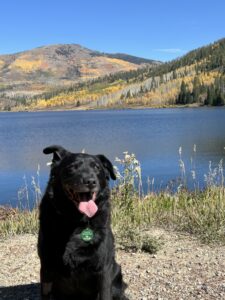
Melanomas are the most common oral tumor in dogs and have the highest potential to metastasize. The most common treatment for Oban’s tumor type is to remove the tumor area by removing part of his lower jaw (mandible). That was not a surgery that Healey wanted for Oban.
Instead, Healey began searching for clinical trials available for dogs with cancer. After meeting with several oncologists and surgeons at CSU, she decided that CSU’s oncology team was Oban’s best path forward.
“Oban was always happy to see his human friends at CSU, especially Kris,” she said. “He enjoyed the holiday costumes because everyone would tell him how handsome he is.”
“Being able to spend so much time with Oban over the course of 15 months was an absolute pleasure, and I continuously looked forward to his visits,” said Kris Ibis, CSU clinical trials veterinary technician. “His exuberance inspired and encouraged us as much as our research may have helped him. Stories like Oban’s make what we do feel relevant and important. Oban has a lot of friends here at CSU, and I’m extremely lucky to consider myself one of them.”
Oban was involved in two different trials. His disease progressed in the first clinical trial, so he transitioned into his second clinical trial. The second was a double-blinded study, in which both the owner and the researcher did not know if Oban was receiving the drug or placebo. Oban’s tumor had been growing prior to starting, and it disappeared during the second clinical trial.
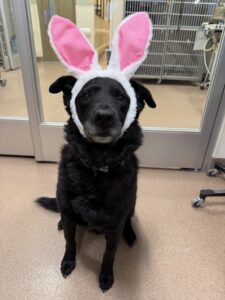
Both trials involved an early morning wake up to travel to Fort Collins from Wyoming. A typical day would include an exam and a 30-minute infusion followed by monitoring for one hour, and at some visits blood would be drawn and X-rays taken. Oban showed no adverse effects to the medication, and the clinical trial has extended his life significantly. Oban is currently happy and healthy.
“The best part was that he had to be observed for one hour after the infusion. This was when the magic happened because it was around human lunch time and he would receive the belly rubs, lots of snacks, and stare longingly at his friends until they shared their lunch with him,” Healey said.
Cancer in dogs is very common. Clinical trials provide an opportunity to not only advance treatment options for animals but for humans as well.
“25 percent of all dogs will be diagnosed with cancer over their lives. That percentage increases to 50 percent for dogs over the age of 10,” said Healey. “Not only are you trying to help your own animal, but you are also helping to advance the science of veterinary medicine and potentially contributing to treatment options for human medicine.”