
Overnight sensation: CSU “equine detectives” return horse to pain-free life
Dr. Lindi Kopecko’s horse, Ostentatious, undergoes innovative spinal surgery at CSU, leading to a remarkable recovery and a return to his competitive dressage career.


Link copied!
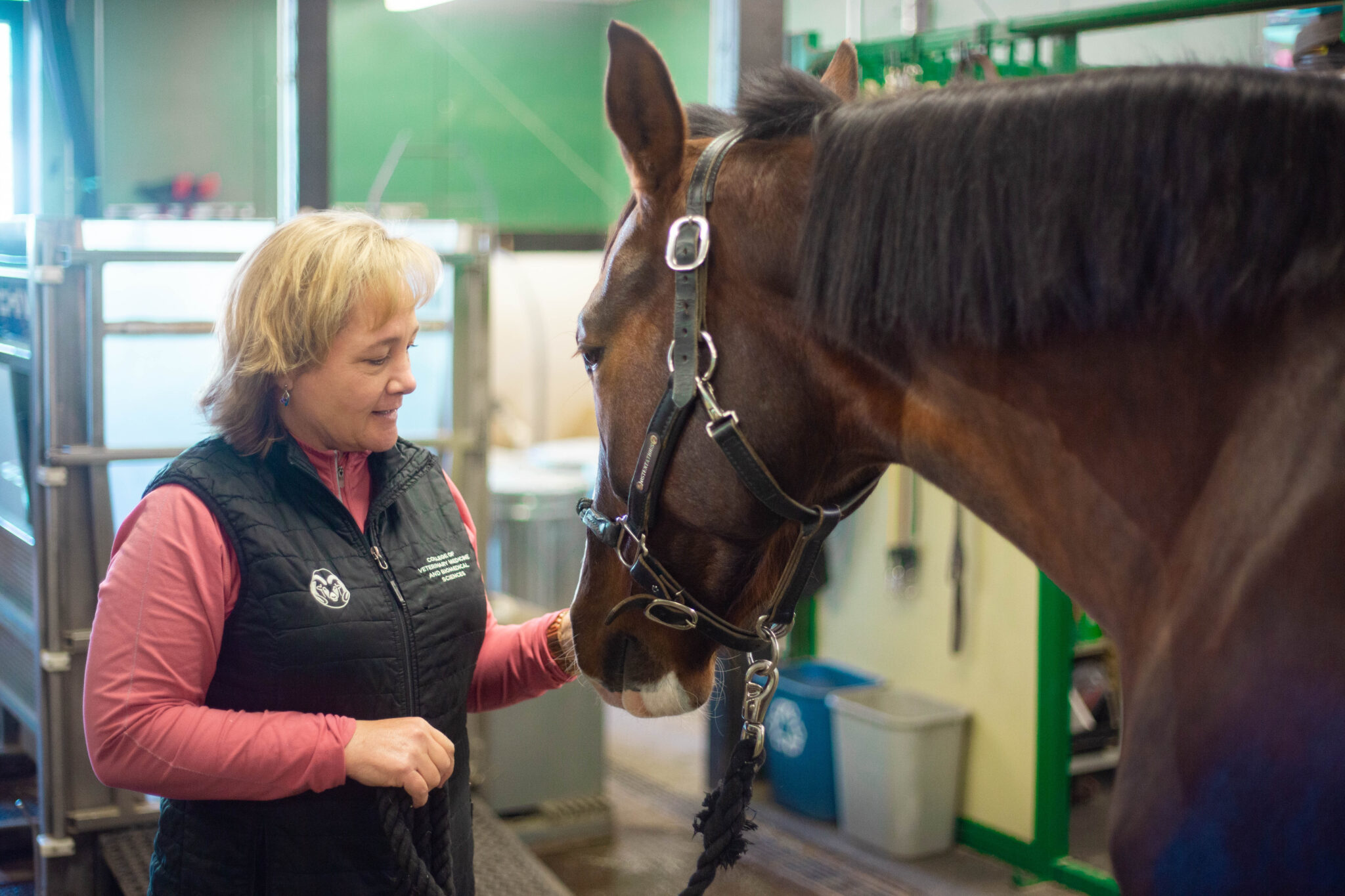
When Dr. Lindi Kopecko got her horse, Ostentatious, at three months old, she thought he was perfect.
“He was the sweetest, kindest, gentlest horse,” Kopecko said. “He just loved being with people, loved being handled, and just was always a dream.”
For five years, the Dutch Warmblood gelding Kopecko calls “Tot,” performed beautifully, winning dressage competitions, and charming his owner’s family.
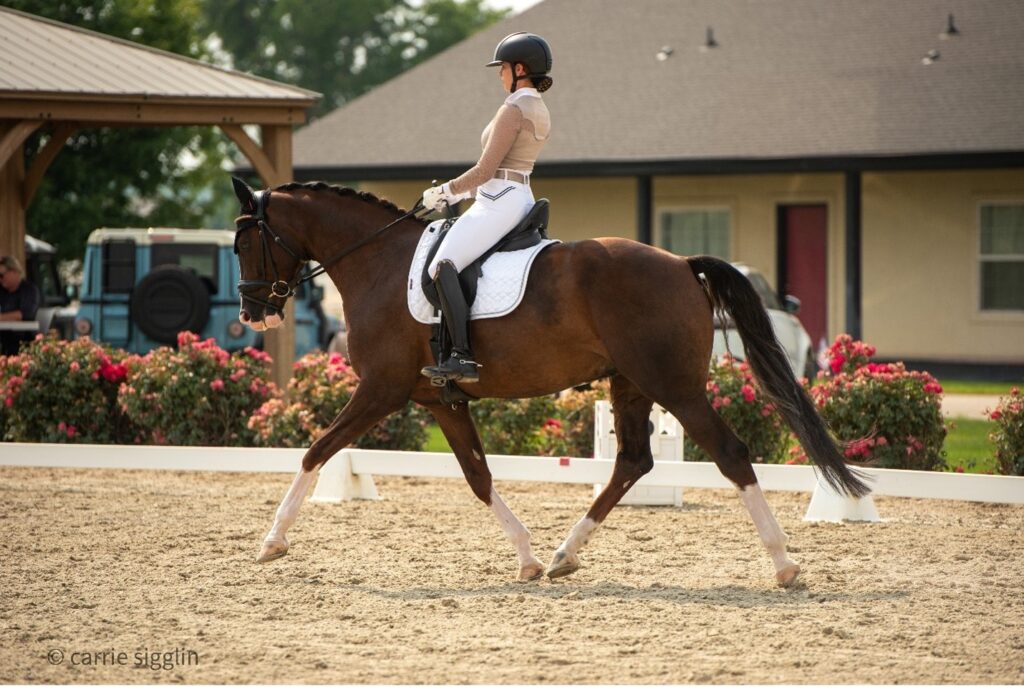
“Never a buck, never a rear, just always quiet and happy, but as time progressed, we started losing that gentle, kind, happy guy,” Kopecko said. “I thought it was a young horse going through a phase — veering, rearing on the lead rope, rearing on the lunge line. In July, he started kicking really bad when I would put the saddle pad on his back.”
Kopecko, a veterinarian at Salt Lake Spay and Neuter, explored the usual ailments that might cause a horse to behave differently.
“So of course I went down the ulcer route, the teeth route, the saddle fit — all those things and nothing helped. I thought ‘he’s just sore, his neck’s fine, but I’ll go get him X-rayed.’”
She sent the radiographs to her longtime veterinarian, Dr. Jamie Higgins at Idaho Equine Hospital, for review. “I’m a vet as well, so as I’m watching the X-rays, I knew. My heart just fell. I knew at that point my horse was dead,” Kopecko said.
Tot had gone from a “perfect,” lovable, winning horse to a kicking, biting animal in obvious pain.
She thought she would have to euthanize him and started to say goodbye. “I was talking to him and petting him, and he wrapped his head and neck around me. That’s when I knew surgery was the right call. It was his decision to go to surgery. He told me what he needed.”
Time to call in the equine detectives
Higgins referred Tot to Dr. Yvette Nout-Lomas at the CSU Johnson Family Equine Hospital.
“I am one of the internal medicine specialists and my special interest is equine neurology. Essentially, I perform diagnostics and guide further treatment. That’s what internal medicine specialists are supposed to be – detectives,” said Nout-Lomas, associate professor of equine internal medicine. “It’s been a spectacular journey to see Ostentatious make such progress through our system, from diagnostics to the rehab and then finally back to Lindi again.”
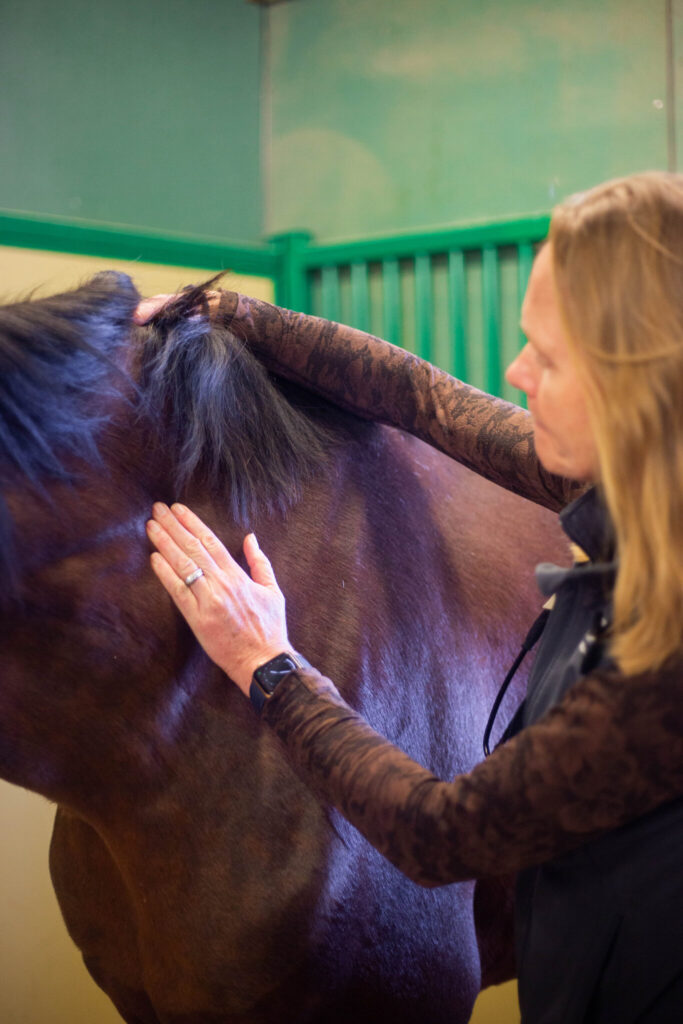
Her clinical examination of Tot showed neurologic signs affecting all four limbs and increased pain on the right side of his body. A CT myelography scan confirmed spinal cord compression, but Nout-Lomas thought surgery could help.
Kopecko was preparing for the worst. “I said if it looks really bad, I still want you to wake him up on the table and I want to take him home and euthanize him, and she’s like, ‘settle down, I think we can help your horse.’”
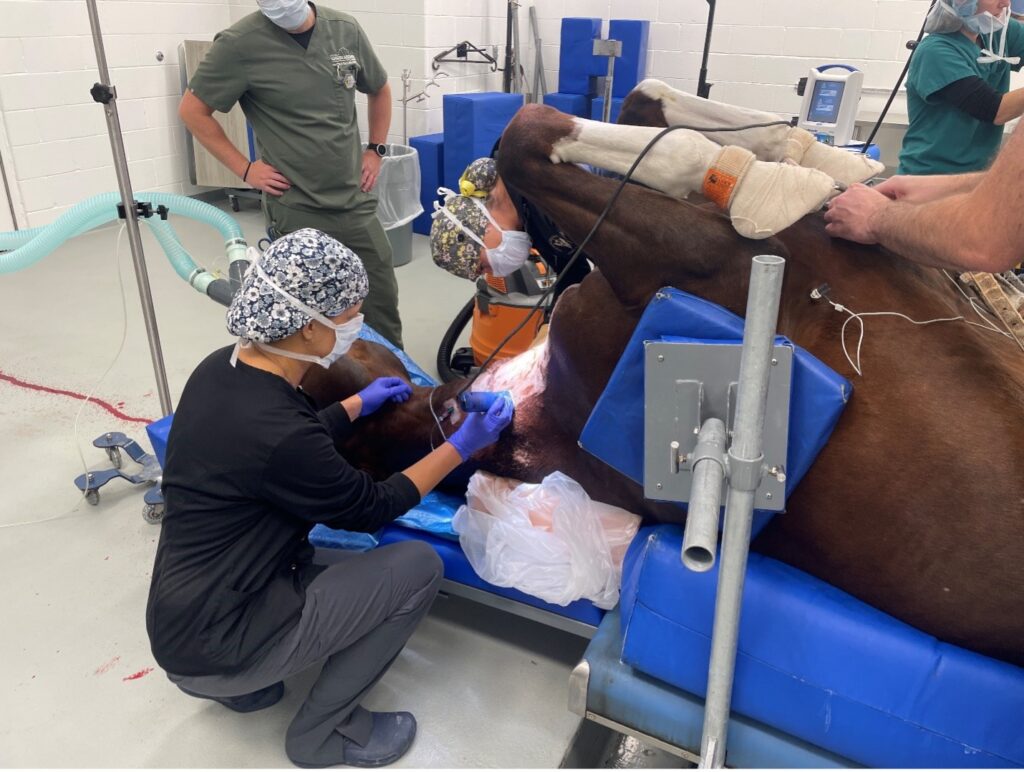
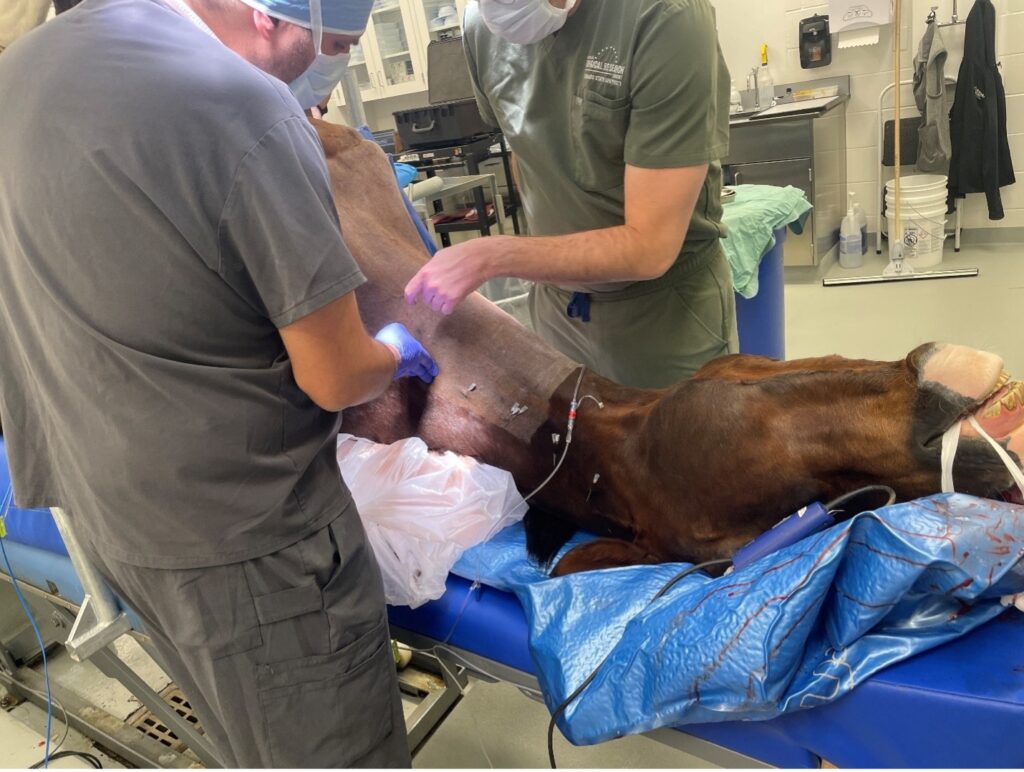
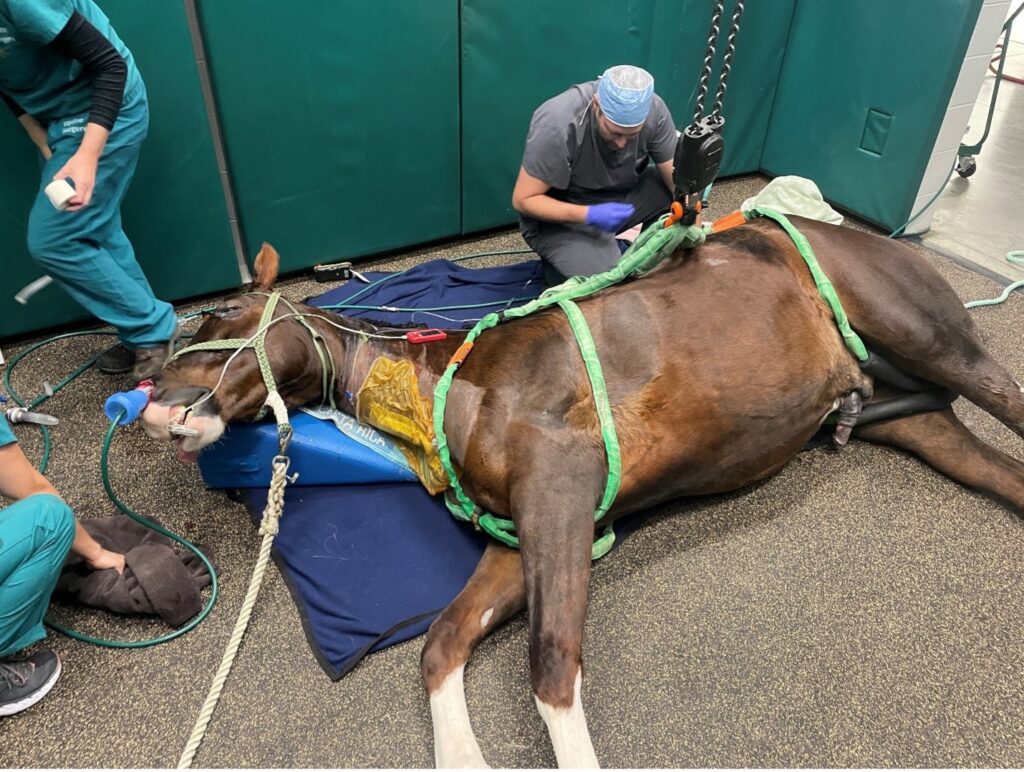
In November, CSU surgeons Dr. Brad Nelson and Dr. Jeremiah Easley, and resident Dr. Machiel Ysebaert performed an interbody vertebral fusion to stabilize two vertebrae in Tot’s neck. “This is actually a technology used in humans that Dr. Easley was testing in sheep and realized that this could be used in horses,” Nout-Lomas said.
The procedure, developed by Easley, uses rods and screws to stabilize the vertebral canal and so prevent further/repetitive damage to the spinal cord. Over time we believe this procedure also creates more space for the spinal cord within the spinal canal.
“Tot was still a little bit upset coming out of surgery that he couldn’t have food, but then the next morning he was a different horse immediately. You could touch him. He was able to stand calmly and quietly. He wasn’t kicking and biting,” Kopecko said. “Overnight it was a different horse.”

Gotta do the rehab
Five days after surgery Tot went to the CSU Equine Sports Medicine and Rehabilitation service, and spent the next three months recovering from surgery and doing exercises to improve strength, balance, and coordination.
“The primary goals of Tot’s rehabilitation were to target proprioception, neuromotor control, and strength,” said Dr. Melissa King, associate professor of equine sports medicine and rehabilitation.
Proprioception is the body’s self-awareness, or knowledge of its movements and position, which is integral to balance. “We did numerous forms of proprioception exercises from proprioceptive balance pads, tactile stimulation, ground poles, serpentine poles, and resistance bands. Strength work involved core exercises, ankle weights, controlled exercise (walker, lunge line, backing).”
With help from the CSU rehab team, Tot was gradually returning to his old self. “He absolutely adored them, and they did a lot of work to get him moving. They are so kind and so loving, very accommodating and very optimistic.”
From despair to optimism
In March, Tot returned home to Utah, where he’s back to his old ways, licking instead of biting, cantering instead of kicking. “He’s just a very sweet, sweet boy,” said Kopecko, who plans to try him under the saddle soon. “He loves to work. He takes his job very seriously. His career is dressage.”
Nout-Lomas told her it would take about a year for Tot to fully recover, with a 65-70% chance of returning to full performance.
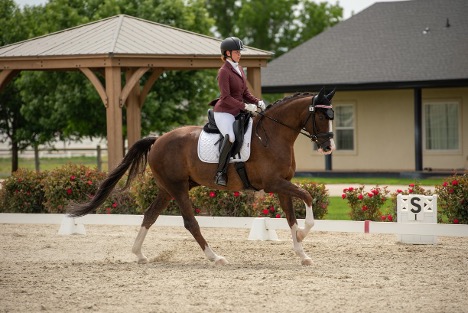
“The hope is to get him back into that. Last summer, he won every class he was entered in with his trainer Morgen Bastow, even with all of this going on and getting worse. He still has such heart, talent, and determination, he maintained under saddle being a good boy throughout the shows.”
Tot’s ordeal will help other horses now, Kopecko says. “Neck disease is showing up more and more in Warmblood horses, and because of Tot, other horses now are getting looked at and getting help sooner in our barn.”
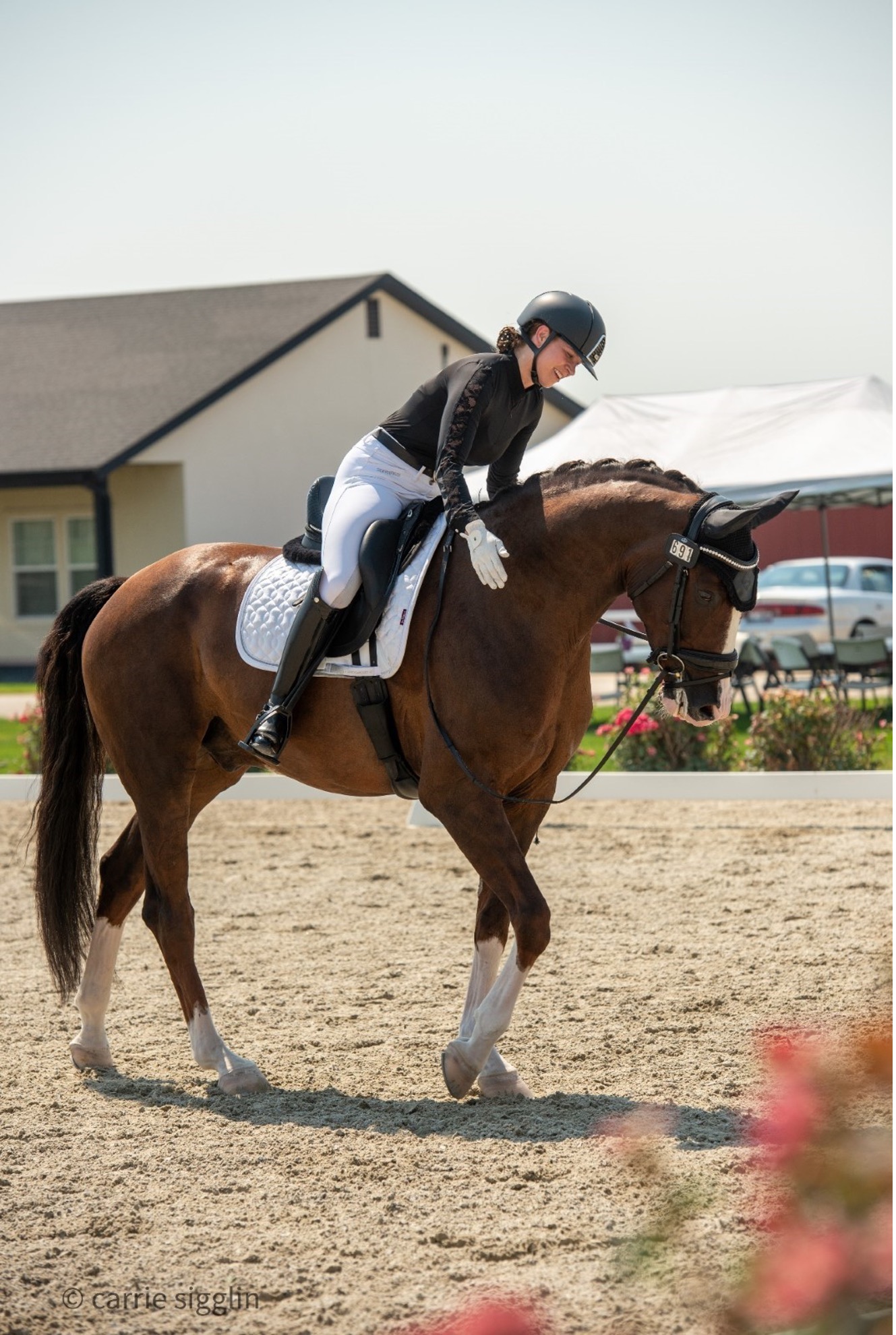
And the CSU folks learned from this case as well. Nout-Lomas credits Kopecko for going the distance with Tot. “I think the biggest thing I learned from this case is how critical altered sensation and overall demeanor are for the horse – owner bond, and how quickly these can be positively affected by treatment or surgery. It is an aspect of horsemanship and equine veterinary medicine that is often overlooked because people are so gait-focused and performance-focused,” Nout-Lomas said. “People forget to think about the rest of the horse. It takes the dedicated client to appreciate that kind of negative change in her horse.”
Kopecko’s young son was the first to ride Tot, and she hopes he will be able to return to the saddle soon, and then on to competition. Case solved!
Veterinary Health System
Colorado State University’s Veterinary Health System is a community of veterinary professionals dedicated to providing exceptional service with passion and purpose. Our experts are animal and public health leaders working together to apply their diverse skills in veterinary care, diagnostics, and education. As a partner of CSU’s top-ranked academic veterinary program, the clinical team works with researchers and educators to advance the future of veterinary medicine.