
CSU veterinary rehab experts and a dedicated family help pup walk again
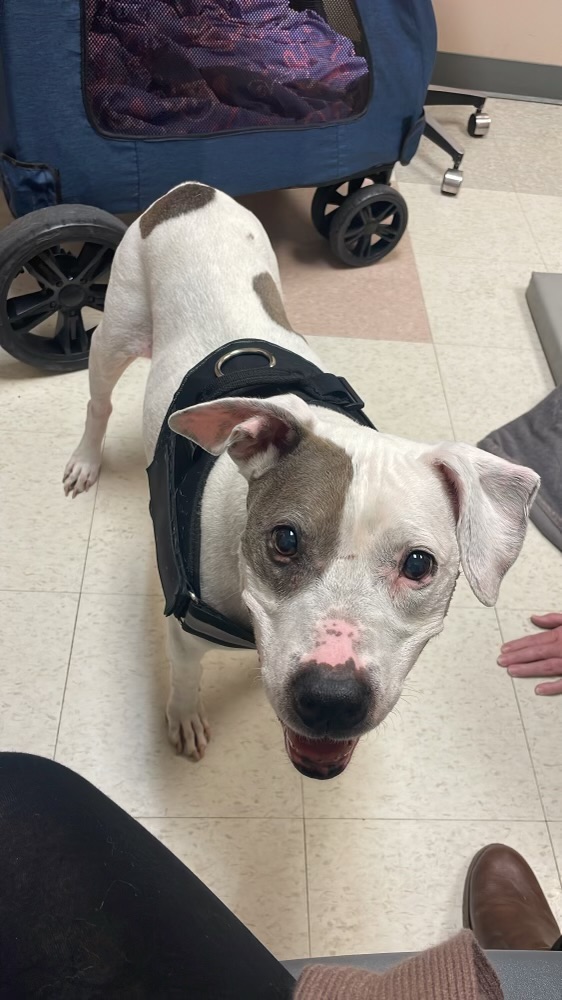
CSU’s rehabilitation department helped Beautiful Brumbelow recover from a severe leg injury that resulted in a limp.


Link copied!
Ready, set, oops!
Beautiful Brumbelow, a playful 12-year-old mixed-breed pup, attempted to jump a temporary fence in her family’s backyard one Sunday morning. Unfortunately, she didn’t quite make it. That seemingly innocent mishap led to a severe injury just a few days later, requiring expert intervention from the Colorado State University Veterinary Health System’s rehabilitation department and dedicated at-home care.
From shelter dog to beloved family member
At age four, Beautiful had spent over a year living in a shelter. Everything changed one day when a high school student and animal-loving volunteer was scheduled to take the friendly pup for a walk. She immediately fell in love with Beautiful and asked her mom, Leanne Brumbelow, if they could adopt her. Soon after, Beautiful joined their family. Daily two- to three-mile walks became part of their routine, which they continued even after moving to Colorado seven years ago.
One too many hurdles
After Beautiful’s fence-jumping incident, the Brumbelows noticed that she had a slight limp, so they carefully monitored her for the rest of the day. The next morning, Beautiful’s toes turned under her feet, and she was unsteady. Concerned, they took her to an emergency veterinarian.
Following evaluation, the veterinary team recommended keeping her quiet and limiting activity to aid her recovery. Committed to helping Beautiful, the family knew keeping her quiet wouldn’t be easy.

“She loves people, loves guests, and always gets so excited,” said Brumbelow.
Three days later, Beautiful tried to jump over the sofa to greet visitors and ended up aggravating her initial injury. Despite their best efforts to restrict Beautiful’s activities, her condition deteriorated, and within days, she could not get up after going to the bathroom.
“She couldn’t move her hind legs, and I could sense she was in pain and scared,” said Brumbelow.
They immediately called their family veterinarian. When they arrived, Beautiful couldn’t walk. The vet recommended hospitalization to keep her immobile and under close observation. Everyone was very concerned.
After two critical nights in the hospital, Beautiful perked up. By the end of the week, she could stand up to go to the bathroom but still couldn’t walk. Although weak, she was discharged and planned to visit CSU’s neurology team early the following week.
Consultation at CSU
When she arrived at CSU on Tuesday morning, Beautiful still couldn’t walk. After the neurology team completed an assessment, Beautiful was referred to the rehabilitation service.
“I met sweet Beautiful the day she arrived for her physical therapy evaluation,” said Sasha Foster, MSPT, CCRT, and CSU veterinary rehabilitation coordinator. “She was smiling and kind from the first moment.”

At her initial evaluation, she received a thorough pain management treatment to decrease inflammation. Following physical therapy, Foster wheeled Beautiful to the lobby in a blue stroller to meet Brumbelow.
“Sasha unzipped the stroller, and I couldn’t believe it when Beautiful slowly stepped out and walked a short distance to me,” said Brumbelow. “She wagged her tail for the first time in over two weeks!”
Foster recommended weekly physical therapy appointments, pain management, and at-home exercises to improve her strength and work toward normal function.
“With neurology cases, recovery is never a straight line. The neurologists recommend seeing if there is progress about every two weeks. If there is progress every two weeks, the pet may continue to improve.”
After Beautiful’s second physical therapy appointment, she was cleared to take short walks outside.
“We had trouble holding her back,” said Brumbelow.
Commitment and recovery

Beautiful continued to progress thanks to Brumbelow’s dedication to at-home exercises and commitment to regular rehab appointments. After two months of weekly sessions, including walks on an underwater treadmill, Beautiful graduated from physical therapy.
“A huge component in her recovery was her owner’s dedication,” said Foster. “Leanne did an incredible job of initially limiting her activity and completing her home exercises, then slowly increasing her activity level within the prescribed home exercise plan. We only see pets 1 to 2 times per week. Continuity of care is provided by the owners at home. Leanne’s care of Beautiful at home was a key factor in her recovery.”
Brumbelow believes the partnership with CSU was the reason for Beautiful’s outcome. “I think CSU’s knowledge and expertise combined with the fact that we kept her fit with regular walking are the reason she recovered,” said Brumbelow.
“We went from thinking we were going to lose her to going back to our regular daily walks,” said Brumbelow. “It’s pretty miraculous.”
Beautiful and Brumbelow will still need to complete regular exercises at home to strengthen her core and manage sore muscles. Because she is predisposed to injuring her back, Beautiful’s high-jumping days are behind her.
“All four on the floor is the best motto for Beautiful,” said Foster.