Orthopedic Surgery
 Cats and Dogs
New main entrance now open
For all visits, enter through the south-facing doors. Look for signs labeled “main entrance.”
Using state-of-the-art orthopedic techniques and technology, we surgically treat injury and disease of the musculoskeletal system, which includes the bones, joints, ligaments, muscles and tendons of the body. Our team of vet orthopedic surgeons aims to enhance the quality of life of pets and their owners by easing pain, restoring function and stability, and improving range of motion.
We partner with the hospital’s orthopedic medicine and mobility service to develop the best treatment plan for your pet. Learn more about non-surgical and rehabilitative options for musculoskeletal issues.
Support our work by giving to the Orthopedic Surgery Support fund.
Contact Us
- For appointments, complete the appointment request form or email us at [email protected].
- For suture removal or rechecks, email us at [email protected].
- For referrals and consultations, complete the referral form or email us at [email protected].
Orthopedic Surgery services
- Bone deformity correction:
- In-house computer-aided design (CAD) planned and executed with 3D-printed patient-specific surgical guides
- Femoral and tibial deformity with patellar luxation
- Antebrachial (forearm) growth deformities
- Bone fracture stabilization: Involves the use of minimally invasive techniques to treat bone fractures.
- Cruciate ligament tear treatment:
- Arthroscopic joint evaluation
- Tibial plateau leveling osteotomy (TPLO)
- Tibial wedge osteotomies for excessive tibial plateau angle (eTPA)
- Extracapsular suture stabilization (ex-cap suture)
- Developmental joint treatments:
- Joint resurfacing using osteochondral grafts
- Unloading osteotomies for OCD
- Elbow dysplasia treatment:
- Arthroscopic fragment excision
- Subtotal coronoid ostectomy (SCO)
- Proximal ulnar osteotomies
- Hip dysplasia treatment:
- For immature hip dysplasia (hip-laxity stage)
- Juvenile pubic symphysiodesis (JPS)
- Pelvic osteotomy (TPO/DPO)
- For mature/adult hip dysplasia (osteoarthritis stage)
- Total hip replacement (THR)
- Femoral head and neck ostectomy (FHO)
- For immature hip dysplasia (hip-laxity stage)
- Integrated orthopedic care: Combined surgical, medical, and rehabilitation services to provide comprehensive care for your pet
- Patellar luxation treatment:
- Femoral trochleoplasty
- Tibial crest transposition
- Soft tissue imbrication/release
- Corrective femoral and tibial osteotomies
Conditions we treat
- Angular limb/bone deformities: Often developmental abnormalities in growth that alter bone and joint growth and are important to identify early and provide interventions; may require CT for planning
- Bone fractures: Trauma is the most common cause of bone fractures, and most require surgery because dogs and cats walk on all four limbs.
- Cranial cruciate ligament tear: Similar to an anterior cruciate ligament (ACL) injury in humans, tearing, stretching, or degeneration causes discomfort in the knee joint due to instability, abnormal movement, and inflammation.
- Elbow dysplasia: An abnormal development of the elbow joint that results in lameness and discomfort.
- Hip dysplasia: An abnormal development of the ball-in-socket structure of the hip joint. It begins as an excessive “looseness” in the joint that causes pain as the surrounding muscles and tissues are stretched, and progresses to an arthritic condition.
- Joint trauma and luxations: Similar to bone fractures, we can reduce and stabilize the joints using augmentation strategies.
- Patellar luxation: Also called “dislocating knee cap” because the patella moves out of its normal location. In most early cases, a pet will suddenly yelp and lift its leg off the ground for a short period of time, followed by a return to relatively normal limb use as the patella returns to its normal position. These episodes of sudden lameness often increase in frequency over time, and the patella may remain dislocated as the condition becomes more advanced.
- Other developmental joint diseases: Osteochondrosis (OCD), limb malformations, metabolic bone diseases
Specialized technology
- Arthroscopic surgery: With a small (2-3mm) fiberoptic tube called an arthroscope, we can examine, diagnose, and treat damage inside of a joint. Used for a variety of conditions affecting the elbow, shoulder, knee, and hip joints, this minimally invasive procedure avoids the need to open a joint up with a traditional surgical incision.
- CAD planning and 3D printing: Using state-of-the-art software, we can provide accurate and thorough assessment of orthopedic conditions. We can perform virtual corrections and 3D print life-size models of a patient for planning and rehearsal procedures prior to conducting the actual procedure on the patient. We can 3D-print patient-specific guides that result in less time in surgery, more surgical precision, and improved patient outcomes.
- High-quality orthopedic implants: Not all surgical implants are created equally. We use high-quality implants to help us deliver high-quality results. Our faculty have direct experience with product development, innovation, and first in use.
- Intraoperative imaging (fluoroscopy): Using a C-arm X-ray imaging system, we are able to treat bone fractures with minimally invasive techniques, promoting faster return of comfortable limb function for our patients. This also allows more accurate intraoperative assessments providing smoother operative care.
- Rehearsal surgery: Using life-size, 3-D skeletal models of a patient, we can plan and perform rehearsal procedures prior to conducting the actual procedure on the patient, resulting in less time in surgery, more surgical precision, and improved patient outcomes.
We partner with the hospital’s Diagnostic Imaging service to provide advanced imaging technologies and services to our clients.
A dedicated member of the Anesthesia and Pain Care service will be assigned exclusively to the task of closely monitoring your animal’s vitals and potential side effects during any procedure requiring pain management, sedation, or anesthesia.
Request an appointment
To request an appointment, complete the appointment request form. Once you have completed the form, our team will contact you to schedule an appointment.
If you’d like to schedule a suture removal or recheck appointment for a problem we’ve seen your pet for within the last six months, email us.
What to expect at your appointment
- Initial consultation: If you have a primary care veterinarian, please let us know during registration. Bring your pet’s medical records, X-rays, medications, or special food to the initial consultation appointment so we can understand your pet’s history and offer the best treatment options.
Following initial evaluation of your pet, we will discuss findings and potential action plans for further diagnosis and/or treatment, including cost estimates. If you wish to proceed with the plan, it may include diagnostics (e.g., X-rays, blood work, CT scan), medications, or hospitalization for surgery. Surgery is often scheduled the day after the initial appointment. - Surgery: It is ideal if you do not feed your pet the morning of your appointment in the event that we recommend sedated procedures. However, please do offer your pet water at all times.
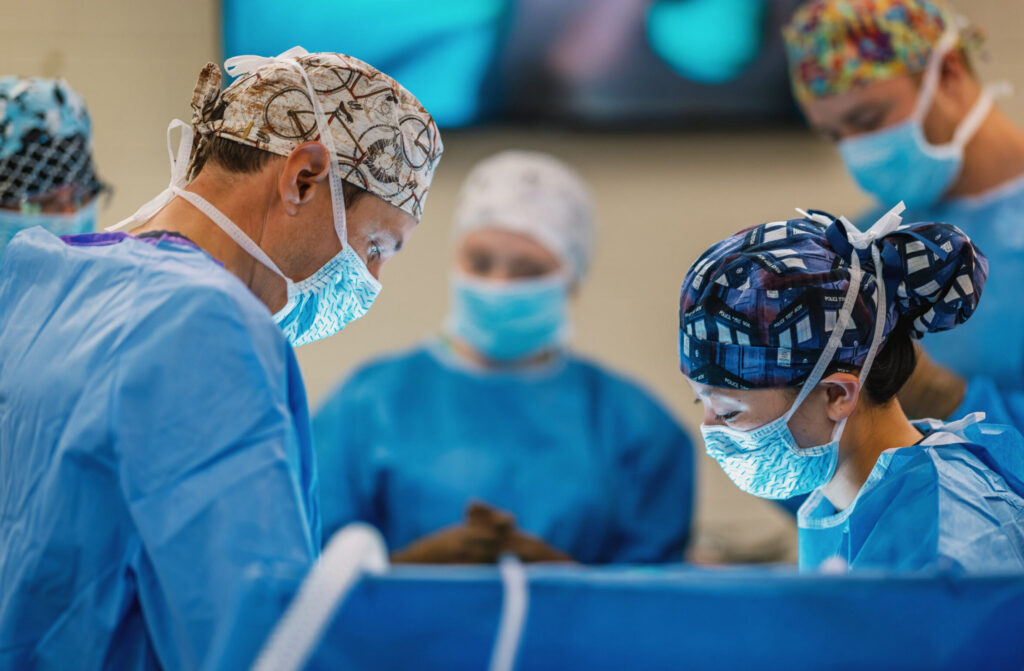
Surgeries are completed by our highly-trained vet orthopedic surgeons together with our surgical residents. Our students may assist during surgeries, but these are largely observational learning experiences for fourth-year veterinary students. In most cases, a pet will be hospitalized for one night after surgery. At the time of discharge, you will be provided a complete set of verbal and written instructions for the care of your pet.
For veterinarians with questions or to refer a case, complete the referral form. Submit medical records and pertinent patient information via email.
Orthopedic Surgery team
Specialists in surgical procedures for musculoskeletal injuries and diseases.
Location
Appointments take place at the Veterinary Hospital and Education Complex.
Taking care of your animal