Orthopedic Medicine and Mobility
 Cats and Dogs
New main entrance now open
For all visits, enter through the south-facing doors. Look for signs labeled “main entrance.”
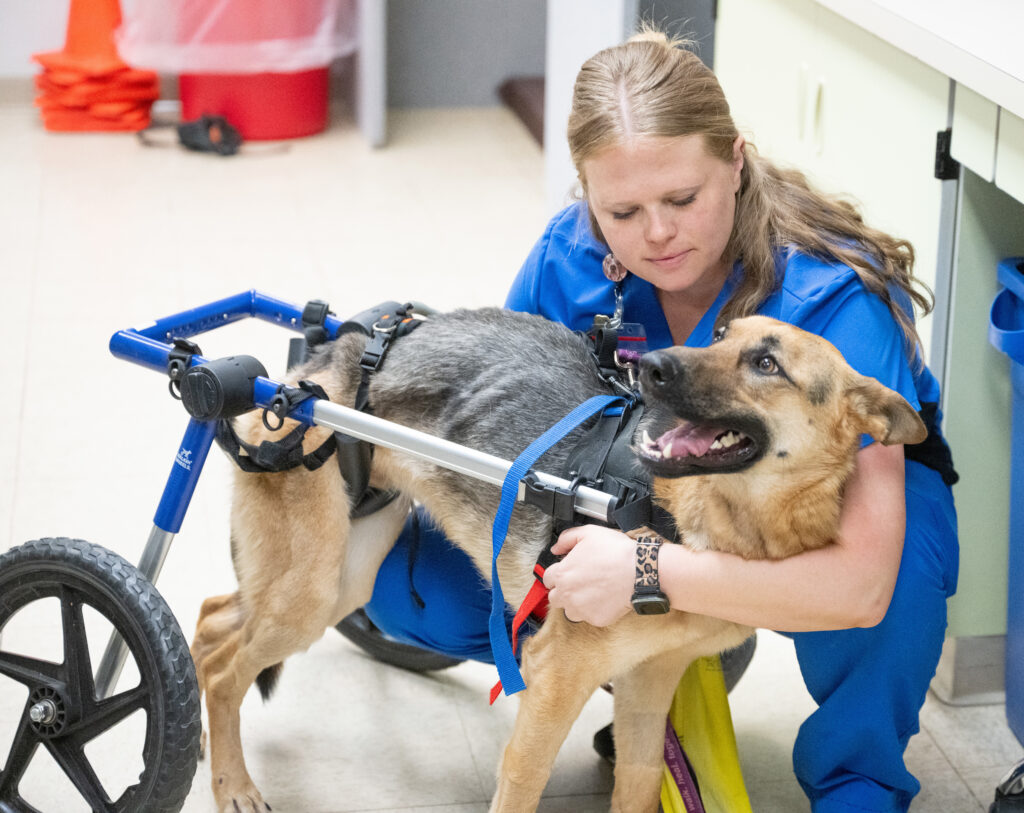
Through prevention, diagnostics, and non-surgical treatment options, we aim to improve quality of life for companion animals of all ages by restoring mobility, alleviating pain, and improving fitness. Our board-certified specialists see companion animals with all types of joint, muscle, and tendon injuries and diseases, including arthritis and canine cruciate ligament injury.
We offer thorough orthopedic evaluations, diagnostics, and non-surgical treatment options for pets experiencing impaired mobility. In addition, we can help prevent joint and muscle disease and improve overall function through regular screenings that may include objective gait analysis and integrated weight management programs.
If your pet does require surgical intervention, we partner with the hospital’s Orthopedic Surgery service to develop the best treatment plan.
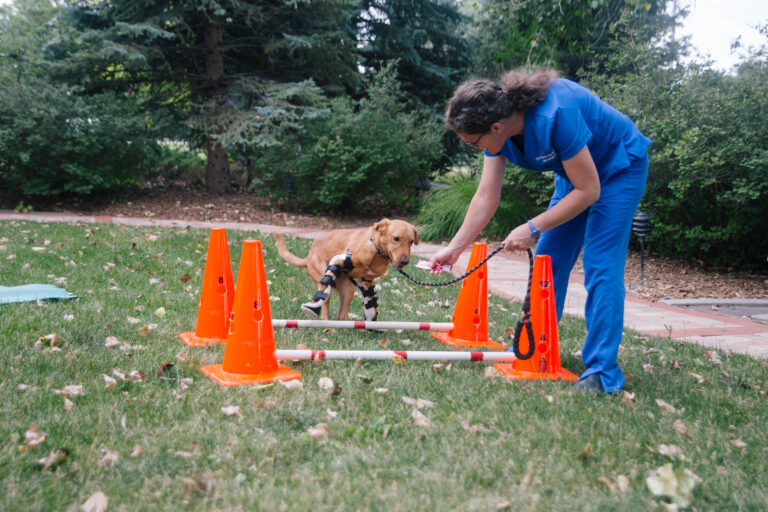
The hospital’s Rehabilitation and Physical Therapy service provides evaluations, treatments, and home exercise programs to promote the highest level of functionality or sports activity.
Support our work by giving to the Ketcher fund.
Contact Us
- For appointments, call the main hospital line at (970) 297-5000 or complete the appointment request form.
- For rechecks within one year, email us at [email protected].
- For consultations and questions, call us at (970) 297-3711 or email us at [email protected].
- For rehabilitation inquiries, call us at (970) 297-4344 or email us at [email protected].
- For clinical trials, email us at [email protected].
Specialized technology
We use state-of-the-art technology to provide an accurate diagnosis for your animal and offer a variety of novel treatment options for orthopedic conditions.
Diagnostics
Diagnostic imaging
We partner with the hospital’s Diagnostic Imaging service to provide advanced imaging technologies and services to our clients:
- Radiographs (X-rays)
- Diagnostic ultrasound
- Magnetic resonance imaging (MRI)
- Nuclear scintigraphy
- Positron emission tomography and computed tomography (PET/CT)
Objective gait analysis
Identifying asymmetry in gait or limping will often require more than a visual evaluation of the animal walking. Objective gait analysis is a non-invasive diagnostic test that involves walking across a state-of-the-art pressure sensitive mat, which collects data like the amount of pressure applied by each paw, length of the stride, and the force generated when walking or trotting. This allows us to precisely determine which paw(s) or limb(s) is causing the abnormal gait.
The first gait analysis may support findings from our examination, or uncover abnormalities not noted before. Once a baseline gait analysis is performed, we can use this data to monitor how your dog is doing by performing gait analysis during each recheck exam.
- Baseline profile: When used together with our physical and orthopedic examination, a gait analysis can allow us to see just how much of an effect the lameness may have on the patient, and identify a problem that is not obvious with visual examination. It can help us differentiate which limb is more affected in cases where multiple limbs may have pain or discomfort, such as hip dysplasia where both hips are affected.
- Early detection of orthopedic problems: It is much better to treat orthopedic problems before they progress into a major problem. The pressure sensitive mat (the device that collects gait data, pictured to the right) is more sensitive than our visual (subjective) lameness examination. Objective gait analysis can pick up even the most subtle factors affecting your dog’s gait, which might have otherwise gone unnoticed. By showing us how much body weight is placed on limbs, we can create a pressure profile and determine if discrepancies exist between the front and hind paws, or left and right paws. Detecting these changes in gait patterns can guide us on what is needed for further evaluation and work-up.
- Monitoring the effect of treatment: When performed at follow-up visits, objective gait analysis can allow us to monitor a patient’s progress and response to therapy. This helps us to determine if our treatment is working or is we should pursue other options; for example, if treating a dog for chronic osteoarthritis we may determine that another pain medication or joint injections are needed.
- Orthopedic or neurologic? Objective gait analysis can also help identify gait abnormalities due to an underlying neurologic disease, as it can detect changes in stride length, paw placement, and variation of each foot strike. Certain neurologic disorders will cause large variations in these values, whereas orthopedic conditions do not.
Treatments
- Cold laser therapy: A beam of laser light applied through an aperture enters the body and has physiological effects used for pain relief and to accelerate tissue healing. The cold laser can be used as a stand-alone treatment or to prepare the body for other treatments, such as manual therapy or stretching.
- Extracorporeal shockwave therapy: High-pressure shockwaves are applied through an aperture and travel through soft tissues but release their energy at tissue sites of greater densities (like where bone and tendon meet). This release of energy activates powerful tissue healing; for example, shockwaves are used in people to break up kidney stones. Shockwave therapy is often used to treat ligament and tendon conditions, as well as arthritis, and can also be used to accelerate bone healing.
- Electrical stimulation: Used to treat pain and aid with tissue healing and reversal of muscle atrophy. Small electrodes are placed over the painful or injured tissue and a small electrical current is sent through the electrodes to promote pain management or tissue healing.
- Game Ready dry cold compression: Provides an automated combination of icing and compression, and is used to reduce post-operative swelling and control pain. We use Game Ready after every surgical intervention, but it can also be used for animals with sprains or strains that don’t require surgery.
- Land and underwater treadmills: The underwater treadmill provides buoyancy to the body and resistance to the limbs to normalize gait, recondition muscles and increase weight bearing capabilities. It can be used after surgery or for muscle strengthening for chronic conditions such as arthritis.
For animals that are unable to use the underwater treadmill due to recent surgical incisions, skin issues, or medical contraindications (like a history of cardiac disease), the land treadmill is used for gait training and muscle reconditioning. - LiteGait: Used for gait training patients who are unable to bear weight through their limbs. LiteGait supports the body with a sling allowing the therapist to manually move the limbs so the patient can walk with assistance, and may be used in conjunction with the land treadmill.
- Manual therapy: Application of forces through a therapist’s hands to mobilize tight muscles or joints. This treatment is used to decrease pain, and increase range of motion and flexibility.
- Platelet-rich plasma (PRP): Improves bone healing and treats common issues like arthritis and tendon injuries. Platelet-rich plasma is made by spinning the patient’s own blood to concentrate the content of platelets, which is then injected into the injured tendon, joint, or bone. Though less costly than stem cell therapy, further research is needed to investigate the efficacy of this treatment.
- Sports conditioning: Promotes the highest level of conditioning for certain activities, and may include treadmill work, balance work, strengthening exercises, and sport-specific training. The purpose of conditioning is to increase competitiveness or return to competition after medical treatment of an injury.
- Therapeutic exercises: Fitness equipment such as blocks, balance discs, wobble boards, therapy balls, and exercise bands are used to strengthen and recondition muscles. Patients often receive home exercise programs that include therapeutic exercise.
If this will be your pet’s first visit, it has been more than a year since we have seen your pet, or we are seeing your pet for a new problem, please complete the following steps to schedule an appointment:
- Complete the appointment request form.
- Once we receive the completed form, we will email you a link to schedule your appointment.
Upload photos, videos, and medical records (if you have them). We appreciate having your pet’s records ahead of time to help us review their history before your appointment.
If we have seen your pet within the last 12 months and your pet has the same problem, email us to schedule an appointment.
If you are a referring veterinarian with a non-urgent consultation or medical question, call (970) 297-3711 or email [email protected].
For rehabilitation inquiries, call (970) 297-4344 or email [email protected].
We will return your communication as soon as possible during office hours.
Orthopedic Medicine and Mobility team
Specialists in non-surgical treatment for orthopedic issues.
Orthopedic Medicine and Mobility clinical trials
View currently enrolling trials.
Location
Appointments take place at the Veterinary Hospital and Education Complex.
Real care, real moments
About the Orthopedic Medicine and Mobility service at the CSU Veterinary Health System.
Taking care of your animal