
A-Maisie-ing recovery: CSU saves the life of beloved therapy dog
After being struck by a car, Maisie Mae was rushed to CSU’s James L. Voss Veterinary Teaching Hospital, where a trauma team worked swiftly to save her life.


Link copied!
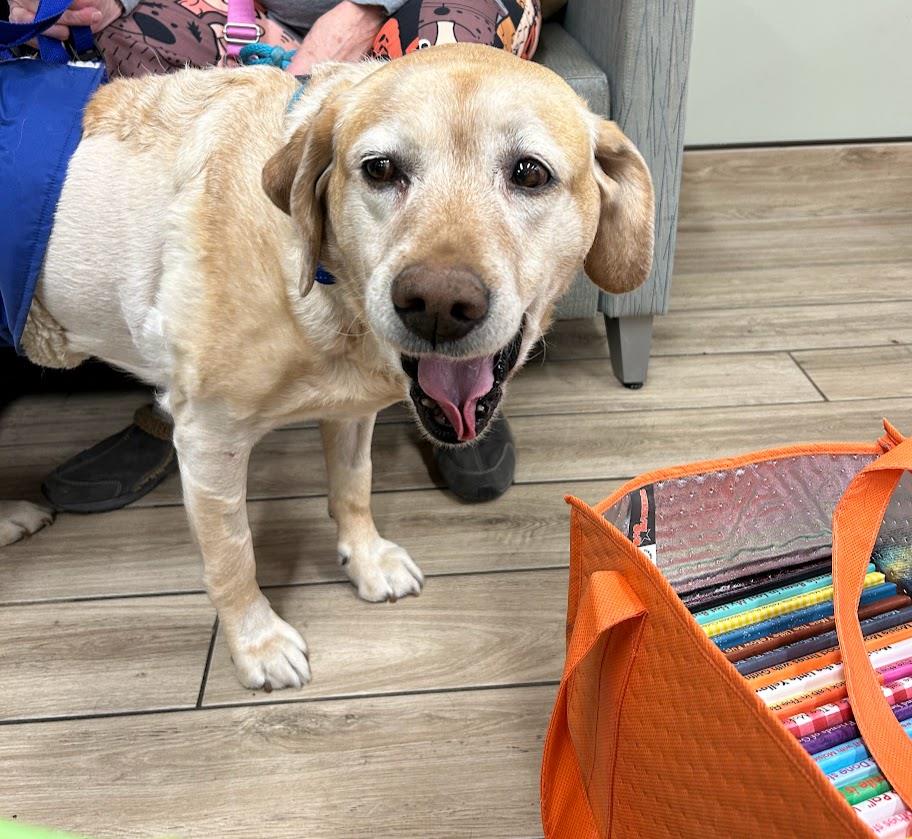
It’s a dog parent’s worst nightmare: Someone left a gate open on the far side of the playground. Your exuberant labs make a run for it just as a car comes down the street. What started as a romp becomes an emergency trip to the vet.
This is just what happened to yellow English Labradors Maisie Mae, 10, and Sheila, 2, at the end of December. Retired teacher Amy Fristoe had taken her three therapy dogs to play at a local elementary school on a Saturday, making sure she closed the gate behind her.
“The two blondes took off in another direction and spotted a gate that had been left open. They saw two other dogs on a trail, and ran across a street in between the parking lot and the trail,” Fristoe said. “I heard a lady screaming bloody murder. Sheila ran to me but I could see Maisie had been hit.”
Sheila was bleeding from her mouth and had minor injuries, but Maisie Mae was lying on the ground, struggling to breathe. “When I got over there, the people that hit them had stayed behind with Maisie. It broke the radiator on their Cadillac, but they were just great,” Fristoe said. “They had just lost their lab a few weeks ago and felt terrible.”
Fristoe raced to nearby Wellington Veterinary Hospital, where X-rays revealed Maisie Mae was leaking air into her chest and fluids into her abdomen. The vets stabilized her and called ahead to CSU’s James L. Voss Veterinary Teaching Hospital, where the emergency room staff was waiting for her.
“At CSU, they met me at the door and took Maisie on a gurney. Her eyes were open and looking at me. I was freaking out,” Fristoe recalls. “But the people at CSU were great.”
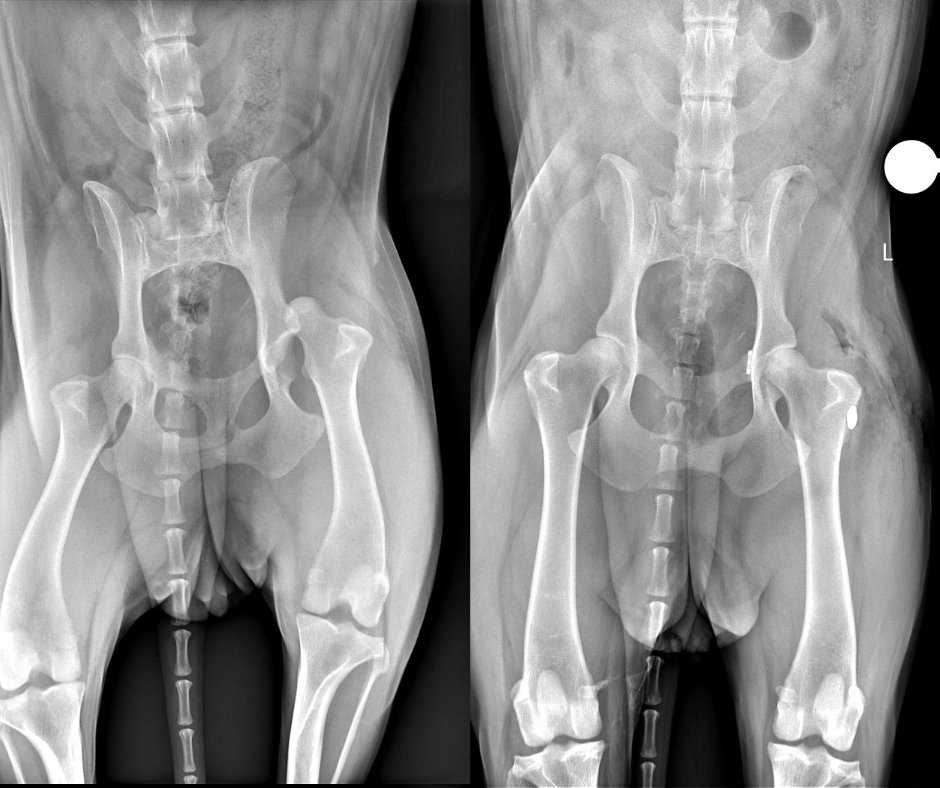
Maisie Mae was alive, with a broken rib, and dislocated hip, but the blood loss and trauma to her lungs were life-threatening.
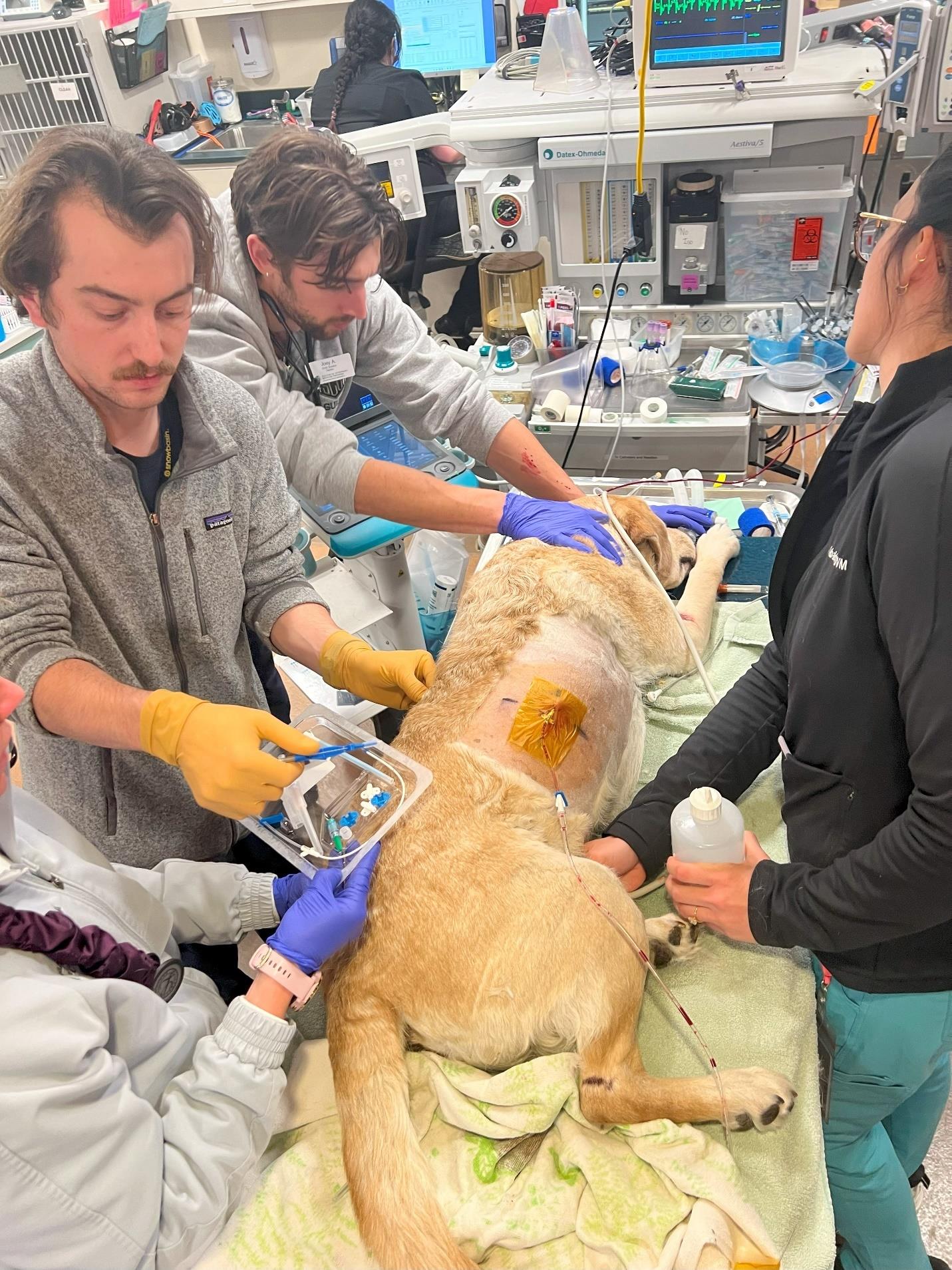
“Maisie Mae came in with hypovolemic shock and severe pneumothorax and was immediately resuscitated by the trauma team,” said Dr. Kelly Hall, professor in the Emergency and Critical Care service. “She received our newly stored chilled whole-blood resource (transfusion) and a whole-body CT, some things that make us unique here at CSU and are requirements for our being a verified veterinary trauma center.”
Multiple hospital services, including Small Animal Diagnostic Imaging, Small Animal Anesthesia and Pain Management, and Small Animal Critical Care, came together to save Maisie Mae’s life.
She spent four days in the Small Animal Critical Care unit, where patients get 24/7 nursing care. Maisie Mae charmed the veterinary technicians, clinicians and students, bringing her therapy dog skills to her caregivers.
“I could tell that she was cognitively with it even though she was on the pain meds,” Fristoe said. “I think she did some therapy with the staff at CSU. She’s such an optimist.”
Her hip was popped back into place under sedation “but it re-luxated, so we took her to surgery and surgically stabilized the hip,” said Dr. Clara Goh, the CSU orthopedic surgeon who performed a toggle procedure on Maisie’s hip joint. “It’s essentially a prosthetic ligament to hold the joint in place, and she orthopedically recovered very well.”
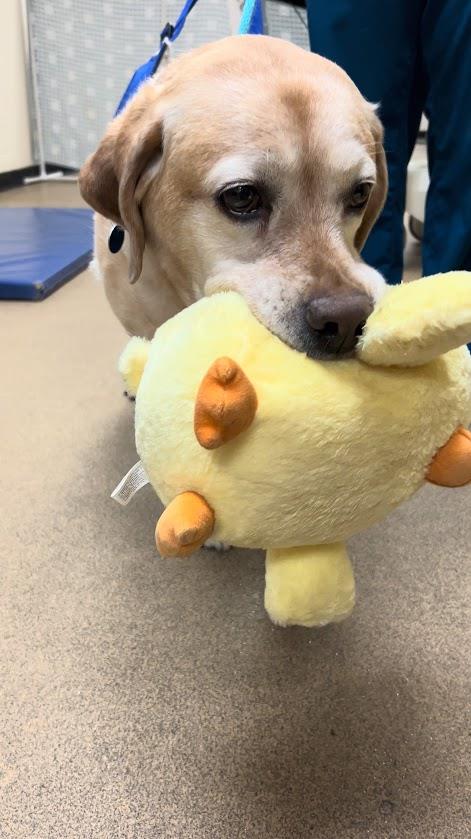
Two weeks after the surgery, Maisie Mae returned to the hospital for a checkup, her “comfort duckie” in tow. Dr. Joey Sapora of the Small Animal Orthopedic Surgery service removed Maisie Mae’s sutures and assessed her range of movement. “She looks really strong for two weeks out, but she will need to be mellow for at least another four to six weeks,” he told Fristoe.
“She’s the leader of the pack,” Fristoe said. “She just wants to play with the other dogs. I have to tell her to slow down.”
Once Maisie Mae is fully recovered, she will rejoin Fristoe and the Larimer Animal-People Partnership on her therapy visits to schools, libraries and hospitals in Northern Colorado.
“She loves the work, she’s so good with toddlers and preschoolers and just everybody,” Fristoe said. “She’s not done yet!”
Veterinary Health System
Colorado State University’s Veterinary Health System is a community of veterinary professionals dedicated to providing exceptional service with passion and purpose. Our experts are animal and public health leaders working together to apply their diverse skills in veterinary care, diagnostics, and education. As a partner of CSU’s top-ranked academic veterinary program, the clinical team works with researchers and educators to advance the future of veterinary medicine.