How poor air quality can impact dogs
Our doctors are adapting the Air Quality Index so that pet owners can more easily understand how poor air quality impacts animal health and know what to do to keep everyone safe.


Link copied!

This summer, with wildfires burning across Colorado and the Western U.S., poor air quality has become a regular occurrence along the Front Range. Knowing how to manage the hazards associated with wildfire smoke and air pollution, which experts at Colorado State University refer to as being “air aware,” is increasingly important. This is true not just for people, but for pets as well.
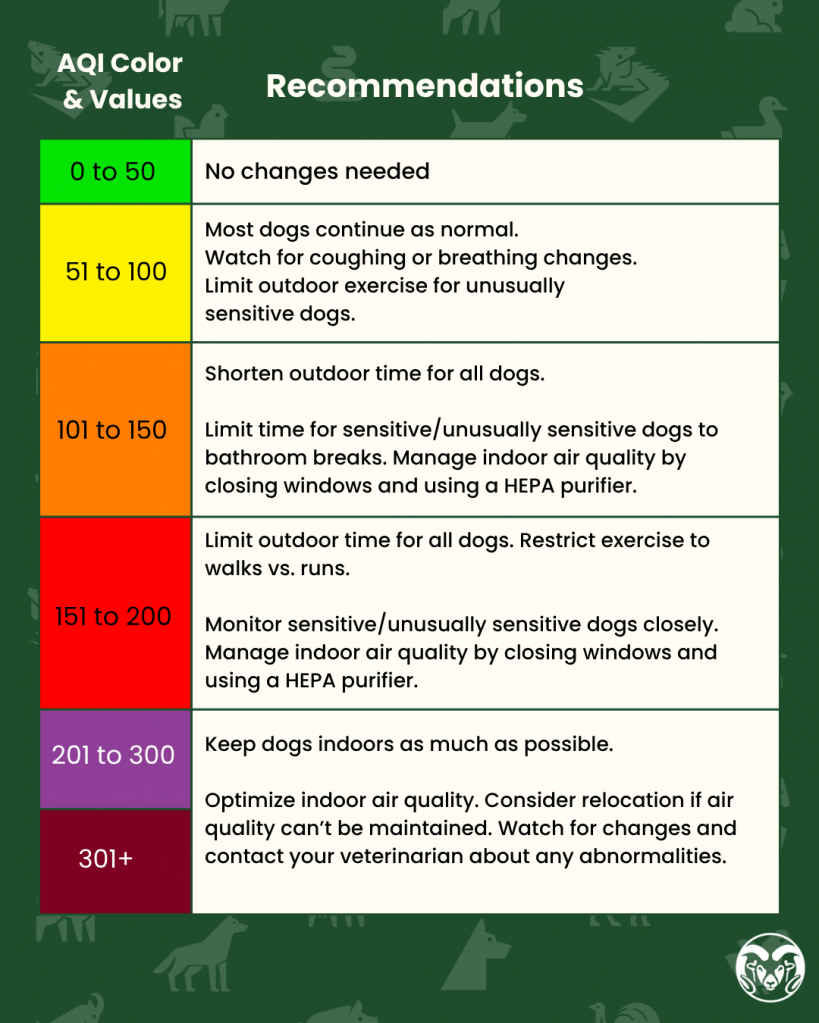
Here, doctors at CSU’s College of Veterinary Medicine and Biomedical Sciences are adapting the Air Quality Index – a scale developed by the U.S. Environmental Protection Agency that rates air quality based on five major pollutants – so that pet owners can more easily understand how poor air quality impacts animal health and know what to do to keep everyone safe.
“Just like you do with the weather, get in the habit of checking the AQI in the morning so you can plan ahead,” said Dr. Colleen Duncan, a professor in CSU’s Department of Microbiology, Immunology, and Pathology who studies how the environment affects animals. “a good rule is to exercise dogs in the morning when ozone levels tend to be lower as are your chances of heat stress.”
AQI for dogs
The AQI scale runs from 0 to 500; the higher the number the worse the air. Readings higher than 100 are considered unhealthy for sensitive groups, and readings higher than 150 are considered unhealthy for everyone. Duncan and her colleagues Craig Webb, D.V.M., Sheryl Magzamen, Ph.D., postdoc Danni Scott, and D.V.M. student Maddy Evans have been working to adapt the scale for sensitive and unusually sensitive dogs. Previous work has shown that most dog owners, including those who are concerned about air quality, rarely check the AQI.
The unusually sensitive category includes brachycephalic breeds such as bulldogs and pugs; puppies; geriatric dogs; pregnant dogs; dogs with a known heart, lung, or airway condition; dogs with advanced metastatic cancer; and dogs on chemotherapy or immune suppressing medications.
The sensitive category includes all of those dogs plus dogs that are overweight or obese; senior dogs; dogs with mild or intermittent heart, lung, or eye conditions; dogs with allergies; dogs with an endocrine disorder such as diabetes or hypothyroidism; breeding male dogs; or dogs with an immune mediated disease.
AQI green (0 to 50)
No changes needed.
AQI yellow (51 to 100)
- Most dogs continue as normal; watch for coughing or breathing changes.
- Unusually sensitive dogs should have outdoor exercise limited.
AQI orange (101 to 150)
- All dogs should have shorter, lower intensity outdoor time. Consider walks instead of runs and go out during better air quality windows.
- Sensitive and unusually sensitive dogs should limit outdoor time to bathroom breaks.
- Manage indoor air quality: close windows, run AC on recirculate mode, use a HEPA purifier if available.
AQI red (151 to 200)
- Limit outdoor time. Exercise should be restricted to low intensity (walks instead of running or intense play). Monitor the AQI for improvements and do outdoor activities at that time.
- Optimize indoor air quality by closing windows and doors; using an HVAC system with an up-to-date air filter; run AC in recirculation mode; add a portable HEPA air purifier or a DIY box fan and filter setup; remove other indoor air pollutants such as candles, incense, diffusers, and aerosols; keep surfaces dust free.
- Monitor sensitive and unusually sensitive dogs closely.
AQI purple / maroon (201 and above)
- Keep dogs indoors as much as possible, monitor the AQI for improvements and do outdoor activities at that time.
- Optimize indoor air quality and consider relocating sensitive or unusually sensitive dogs to cleaner air if indoor air quality can’t be maintained.
- Watch for any changes in behavior or symptoms and contact a veterinarian if anything abnormal appears.