
Silly Goose recovers from tummy trouble at CSU Veterinary Teaching Hospital
Goose, a mischievous 70-pound Catahoula rescued from euthanasia, faced another health scare after recovering from abdominal surgery. His devoted owners turned to Colorado State University’s Small Animal Emergency and Urgent Care service, where compassionate care and financial support helped them navigate a difficult moment—and reminded them why CSU is a trusted resource for both pets and their people.


Link copied!
Goose, a 70-pound Catahoula, known counter-surfer, and all-around naughty boy, had already recovered from a surgery for an intestinal obstruction when he started showing signs of another tummy ache. Even though his owners, Marsena Holsopple and CJ Malament, had locked trash cans and were careful to keep him out of trouble, they knew something was wrong.
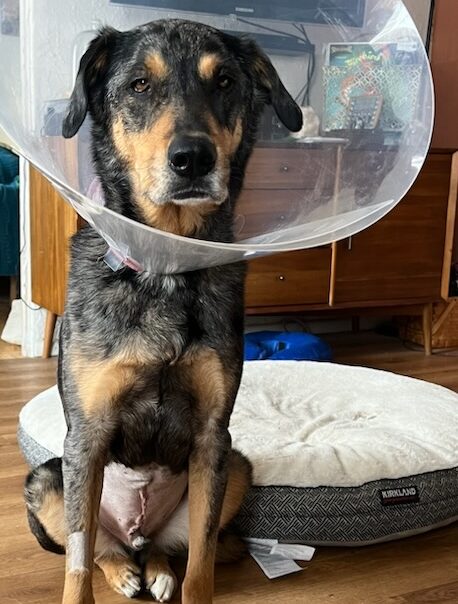
Seven years ago, the couple rescued 6-week-old Goose from euthanasia at a Denver shelter, where he had come in unconscious, with heatstroke, pneumonia and roundworms. He is a “real nerd,” and an integral part of their family.
“CJ had worked in animal care and said, ‘we have to take him to the vet school because they are the best,’” Holsopple said. They made the 1½-hour drive from their home in Denver up to Fort Collins, worried about Goose, and worried about their finances.
“I was really familiar with CSU and their amazing team,” said Malament, who worked with the Denver Dumb Friends League, now Humane Colorado, for 10 years. “We were just really freaked out with Goose and we weren’t sure what to do. Everybody was just so kind and patient with us. I was bawling and they gave me a quiet room and tissues.”
“I was a wreck. He was a wreck, and the doctors and the students were just so wonderful,” Holsopple said. “We were on a budget, but they were like, ‘OK, we can do this much.’ Such compassionate people go into this work and then have to deal with these conversations all the time.”
Caring for Goose, together
Having just paid for abdominal surgery at a Denver animal hospital, Holsopple and Malament were weighing how much they could afford in getting the treatment Goose needed.
“I’m a realist. I don’t think animals are going to live forever, but I do believe that I committed for his life to care for him. And that, for me, is the crux of it – if there’s a possibility that he’ll have quality of life, because he’s a healthy dog otherwise. So, it was just a terrible situation,” Holsopple said. They thought they might have to say goodbye to the dog they had rescued from the euthanasia list at the Denver shelter.
“I feel for veterinarians and especially for training veterinarians because y’all are going into a field where you’re underpaid, underappreciated, you’re death doulas for a lot of the world’s animals, right? People don’t go in thinking, ‘I’m going to be holding a lot of animals as they pass away.’ But they are helping a lot of people. They’re like a therapist for humans, translating for animals.” Holsopple said.

Luckily, radiographs in the CSU Small Animal Emergency and Urgent Care service did not show any foreign bodies in his stomach, so Dr. Maria Willis recommended palliative care in the hospital to resolve his symptoms. She also arranged for financial assistance to cover some of the costs of his treatment.
Like Holsopple, Willis is a realist. She knows not everyone can afford the level of care required to save an animal’s life.
“Whenever I see people struggling with financial situations, trying to do the best for their dogs, one thing I always tell them is ‘the fact that you are here tells me that you care for your dog.’ As a veterinarian, you have to be thoughtful and put yourself in their place, and also make sure that you give the best care.”
How does she reconcile those difficult decisions? “For me, it’s knowing that I did everything I could, I supported this person and gave them all the information they could use to make the decision. And if they euthanize, at least that patient is not suffering. At least there’s no pain.”
Malament and Holsopple thought they might have to face that difficult decision as they waited for word on Goose’s condition.
“Seeing the smile on Dr. Willis’ face as she came out of the back room at CSU’s emergency clinic after a harrowing and emotional day was an immense relief,” said Malament and Holsopple in a letter to the care team.
Gratitude goes both ways
“We are deeply aware of the immense workload and financial burden becoming a vet entails, and of their often-overlooked contributions to our communities. Not only did the team at CSU take amazing care of Goose, they took care of and advocated for us as well. We also know that unfair expectations are often placed on healers to do their valuable work for free, and would never dream of asking. The financial assistance we received from CSU was an incredible gift, offered quietly and without expectation,” they wrote.
Receiving that letter was its own gift for Willis and the CSU urgent care team. “We’re so appreciative because that moves us and drives us to keep going,” Willis said. “It’s like, ok, someone actually said ‘thank you,’ it really touches our hearts.”