
The art + science of bacteriology
In a building filled with scientists, the Veterinary Diagnostic Laboratories’ Bacteriology Laboratory team operates at the intersection of art and science.


Link copied!
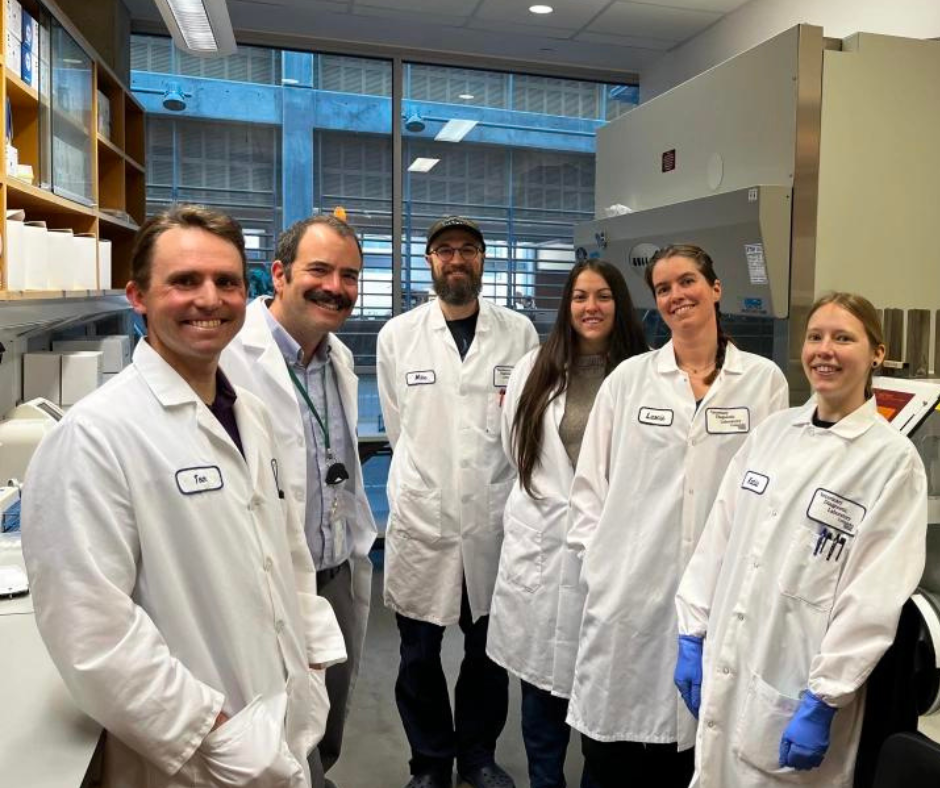
In a building full of scientists, the Veterinary Diagnostic Laboratories’ Bacteriology Laboratory team admits their work is sometimes part art and part science. Samples may contain six different things to look at, so they must isolate each to determine what’s happening. Even then, their results often don’t provide a simple yes or no, which means a certain level of subjectivity and creativity is involved.

“We’re a piece of the puzzle, and we have to determine if our piece fits,” said Bacteriology Section Head Dr. Josh Daniels.
The team includes Laboratory Manager Mike Russell, technicians Leonie Leduc, Katie Page, and Tom Peppard, resident Dr. Blaire MacNeill, and Daniels. They work closely, though everyone has a specific job, and they take pride in solving problems together.
“I can’t imagine working with a better group,” said Page. “They are so knowledgeable, we help each other.”
According to Daniels, the lab isn’t just one person working with one case; everyone is involved, from set up to review to running susceptibility and reporting.
“Teamwork is huge; everyone has a job, and they communicate beautifully,” said Daniels.
Communication with clients is another essential aspect of the job, whether educating clients on aseptic sample collection to ensure accurate results or working with clinicians to piece together information when initial findings don’t quite add up.
“When something we’ve never seen before comes up, the first principle is to look at the quality of the sample,” said Daniels. “It might be a contaminant, so we have to look for corroborating evidence that might be relevant to the case. Talking to clinicians can be key.”
According to the team, it’s important to have a relationship between diagnostics and clinical practice—to educate clinicians as clients and have real-time conversations about patients. The best-case scenario is when clinicians have questions and call for advice on obtaining a quality sample.
About 80 percent of the samples analyzed are from dogs, followed by cats and horses whose owners and veterinarians are waiting for results to determine the best course of treatment. They receive samples from all over the country; in fact, the VHS hospitals only comprise about 10 percent of their sample submissions.
“Charleston, South Carolina, thinks we’re the bee’s knees,” said Daniels.
Lab work
The Bacteriology Laboratory isolates, cultures, and identifies bacterial and fungal pathogens. Their goal is to provide high-quality, actionable results in a timely fashion.
While the work processes are standard, every day has the potential to bring something a little different.
“The variety of what we see makes it interesting,” said Russell. “It’s the surprises that make it fun.”
Peppard, who previously worked in food quality and coal quality testing, is known for having an amazing set of eyes to find the unexpected, like the plague on a cat’s tongue.
“I like the problem-solving in this job, to isolate and figure out what’s important,” said Peppard.
While the unusual makes their jobs fun, the team is also united in their belief about the importance of their work: helping animals and preventing the spread of disease.
“I love the times when we find an answer and know that a dog is going to get better because of what we identified,” said Leduc.
Veterinary Health System
Colorado State University’s Veterinary Health System is a community of veterinary professionals dedicated to providing exceptional service with passion and purpose. Our experts are animal and public health leaders working together to apply their diverse skills in veterinary care, diagnostics, and education. As a partner of CSU’s top-ranked academic veterinary program, the clinical team works with researchers and educators to advance the future of veterinary medicine.