
Charting new paths in veterinary cardiology: A profile of Dr. Brian A. Scansen


Link copied!

Dr. Brian Scansen’s journey into veterinary cardiology wasn’t a straightforward path. If his career were charted like an ECG, the rhythm would look irregular, full of pauses, pivots, and unexpected turns that ultimately shaped his path far more than any long-term plan would.
Scansen grew up on an island in Washington state, between Everett and Snohomish, where, as he put it, life was pretty good, revolving around a river and a cattle farm. Animals were a constant, so becoming a veterinarian felt like the obvious path. At the time, he even assumed Washington state had the only veterinary school. That certainty wouldn’t last long.
What followed instead was a series of unexpected turns – a move to Seattle, a NASA Space Grant, a spray bottle demonstration that reframed how he thought about science, and a career built on curiosity, collaboration, innovation, and an unwavering commitment to shaping the future of veterinary cardiology.
Discovering research
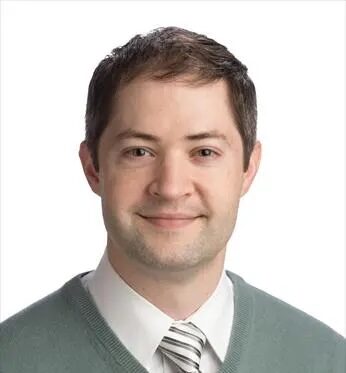
After high school, Scansen and his girlfriend pursued parallel careers in veterinary and human medicine, leading them both to the University of Washington. It was here that he encountered research for the first time. As a NASA Space Grant scholar, he landed in Peter Rhines’s geophysical fluid dynamics lab, drawn in by the idea of studying whales and the “cool” side of ocean science. He quickly learned that oceanography was, at its core, a discipline grounded in physics.
One vivid moment stands out: Dr. Rhines sprayed water from a bottle and asked Scansen to explain the fluid flow. The lesson wasn’t about water at all. It was about questioning, observing, and discovering. Curiosity, Scansen realized, is sparked, not taught. That spark stayed with him.
Veterinary school and the discipline of research
When his now-wife began medical school in Detroit, Scansen enrolled at Michigan State University’s College of Veterinary Medicine. There, he became deeply involved in research on feline calicivirus, a project that eventually led to a master’s degree and more than three years of focused investigation. More importantly, he came to understand that meaningful scientific work requires patience, humility, and generosity.
Residency at Ohio State
A residency at Ohio State University brought Scansen into the orbit of mentors he describes as “gods of cardiology.” He immersed himself in projects that included ultrasonographic cardiac output monitoring and multi‑species hemodynamic studies.
The technical challenges were significant, yet the lasting impression was something much simpler: devotion. His mentors – one now in his nineties and still academically active – continue to demonstrate the lifelong commitment that defines academic medicine at its finest.
Learning through mentorship
After his residency, Scansen stayed on at Ohio State as a faculty member. His first year centered on clinical duties and teaching, until he was assigned a graduate student to mentor. The resident already held a master’s degree from an NIH‑funded lab, prompting Scansen to wonder, “who’s the student and who’s the teacher?”
Together, they began transforming clinical questions into research studies. Scansen and his resident produced some of the earliest publications detailing right ventricular function in canine patients. But what Scansen remembers most is his resident measuring studies late at night, long after clinical duties ended.
Perseverance, he often says, isn’t glamorous; it’s built after hours. That resident is now a full professor and CVMBS colleague – Dr. Lance Visser.
Collaboration as catalyst
If perseverance shaped Scansen’s early career, collaboration expanded it.
At Ohio State, he began working closely with pediatric cardiologists, interventional radiologists, and cardiac imaging specialists. Together, they performed the first perventricular septal defect closure in a dog. In 2009, guided by pediatric interventional cardiologist John Cheatham, they placed the first transpulmonary stent in a canine patient.
The cath lab was outdated. Circuits blew mid‑procedure. But the work was transformative.
These collaborations extended into imaging as well. Sedated bulldogs were transported through hospital back corridors for late‑night cardiac MRIs at the human medical center, enabling some of the earliest descriptions of right ventricular stiffness in dogs as a translational model for human disease.
At first, the learning flowed mostly from human medicine into veterinary cardiology. Over time, it became truly bidirectional, with comparative studies informing both fields.
The lesson: innovation accelerates when disciplines intersect.
Building the heart team at CSU
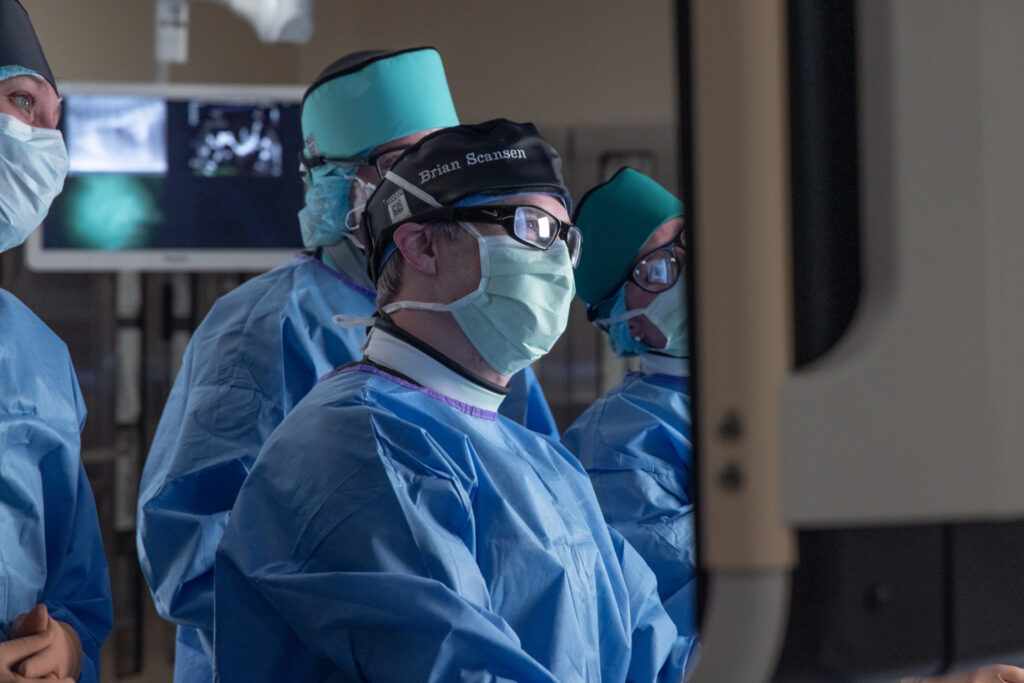
Scansen joined CSU in 2015 with a new vision. He believed cardiology needed a true heart team. He partnered with cardiac surgeon Dr. Chris Orton to build the integrated heart team he had envisioned. In 2016, they established an interventional cardiology fellowship, the first formal program of its kind in veterinary internal medicine. In 2024, after years of advocacy, the American College of Veterinary Internal Medicine officially recognized this training program as the first veterinary interventional cardiology fellowship in the world.
Building this program required more than clinical expertise. It demanded philanthropic support, upgraded space, and institutional belief. Renovations evolved into the construction of a hybrid operating room. Endowed chairs and major gifts helped secure the program’s long‑term future.
Along the way, some of the most meaningful support came from clients who believed in the vision even before it was fully realized.
Today, the program trains fellows, expands minimally invasive options for animals, and strengthens collaborative care across specialties.
Lessons that endure
When Scansen reflects on his career, he doesn’t focus on procedures or publications. Instead, he returns to the moments that shaped him. Curiosity that was sparked in a fluid dynamics lab. Kindness learned through the discipline of research. Devotion modeled by mentors who never stopped learning. Innovation driven by those willing to try what hadn’t been done. Perseverance shown by a resident who measured studies late at night. Collaboration across species, disciplines, and institutions. And teamwork, which is the foundation of every success in cardiology.
Looking back, the rhythm of his journey seems less irregular and more intentional. Each unexpected beat redirected him toward the work he is meant to do.
In cardiology, rhythm matters. In Brian Scansen’s career, it’s the unexpected rhythms that defined the path forward.