
Coming full circle: $10 million gift inspired by a moment in a veterinarian’s lobby
Don Lockton made a $10 million gift to the CSU Veterinary Teaching Hospital after surgeons saved his dog Chief.


Link copied!
Picture a scene in a veterinarian’s office: A young family comes in with their cat, who had been hit by a car. The veterinarian says, “We can save her, but she needs surgery,” and begins to review the cost with the family. The kids are crying, and the parents are saying, “We just don’t have the money.”
Meanwhile, a father and son are witnessing the family’s distress as they are checking out with their dog, who had cancer. The father (who was also undergoing chemo) quietly tells the vet, “Fix the cat. I don’t care what it costs. Please take care of their cat.” The son, fresh out of college, watches this exchange, and goes on to work for his dad’s company, building an international insurance brokerage, alongside his family.
That moment stayed with Don Lockton, one of three brothers who carry on Lockton, Inc., founded in 1966 by his dad, Jack. After Jack died of pancreatic cancer in 2004, his sons continued his philanthropic legacy around the world, through the company and family foundations.
For the past four years, heart patients at the Colorado State University Veterinary Teaching Hospital have received financial assistance through the Chief Lockton Compassionate Care Fund, which supports clients of the Cardiology service. The fund is named for Don Lockton’s Great Dane, Chief, who was diagnosed with heart failure in 2021, when he was just a year old.
Chief’s journey from Kansas City to Fort Collins started a relationship that led to a $10 million gift from the Don Lockton Family Foundation to establish the Don Lockton Family Heart Center in the CSU College of Veterinary Medicine and Biomedical Sciences.
But it all started back in that Kansas City veterinary office more than 20 years ago.
“I thought to myself, ‘That is the coolest thing ever,’” Don Lockton said during a visit to the hospital with his three dogs. “Experiencing that was the inspiration behind it. Coming full circle, when I started the Compassionate Care Fund for dogs and cats, I did it in homage to my dad, who loved his pets as much as anything and always helped others in any way he could.”
Chief was diagnosed with a heart murmur and referred to Kansas State University’s College of Veterinary Medicine. “I got a call from this doctor at K-State, and he said, ‘Your dog has a leaky mitral valve, and it’s basically going to be a terminal heart disease,’” Lockton said. “And I just lost it. I was in a meeting, and when I received this news, I completely lost my mind, because we are so close.”
Dr. Justin Thomason, a veterinary cardiologist at Kansas State, referred Lockton to Dr. Chris Orton, who specializes in open heart surgery to repair congenital defects at CSU.
“Chief had dysplasia of the mitral valve, which is less common but in some ways is more devastating,” Orton said. “It’s less well tolerated, and once dogs start to go into heart failure, it can have a pretty rapid progression.”
Surviving a difficult surgery
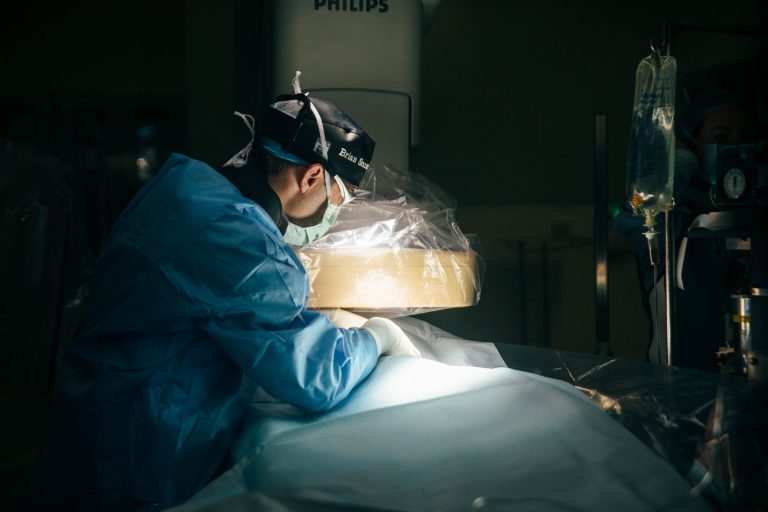
Orton and Dr. Cat MacPhail operated on Chief in July of 2021. “It was a difficult surgery, partially because Chief was in heart failure and had an abnormal rhythm called atrial fibrillation, and there were complications associated with bleeding from the aorta, so we struggled to get him through. Dr. Khursheed Mama and the anesthesia team kept him alive,” Orton said.
The repair went well, but Chief’s aorta tore during catheter removal, and he lost nearly his full volume of blood. “They told me, ‘We’re going to do everything we can, but it doesn’t look good.’ So then I was expecting a call to say we lost him,” said Lockton, who had developed an intense bond with Chief during the COVID lockdown.
“He’s my guy, so I was in really bad shape. And then I got a call, and they said that they were able to repair the torn artery with surgical tape, and they believed he would make it. They said if he makes it through the night, that’s a great sign,” Lockton said. “I went from devastated to having some hope, and lo and behold, I got a call the next morning that he made it through the night, and that things were starting to improve. I was elated.”
At this point, Chief was the focus. The CSU team had no idea that Lockton was in a position to become a donor. He was just a guy who would do anything for his dog.
“I was talking to God, and I was saying, ‘If this team can fix my pup, I want to be able to do the same for others,’” Lockton said. “After they fixed him up, I knew it was time to give back to CSU.”
While riding that wave of emotions, Lockton found himself feeling profoundly grateful. “It’s a roller coaster of hope and despair and hope. The whole time, I was thinking to myself, ‘I am so lucky that I am able to come out here and pay for this.’ I can’t imagine having been told about Chief’s condition, and I couldn’t afford to do anything about it. I don’t want anybody to be in the position I was in and not have the resources to fix it.”
So he started the Chief Lockton Compassionate Care Fund at CSU, followed by a $2 million donation to fund an additional cardiac surgeon from Tokyo, Dr. Shiori Arai, to train with Orton, and cover the cost of at least two open heart surgeries per year for clients in need. To date, the fund has covered over 20 surgeries for families from across the country that could not otherwise afford the procedures.
“Don has helped so many animals, but we started to talk about how do we push this to another level to help us continue to be at the forefront, to train the next generation, to have the newest equipment, to be able to help more animals and cover their care, to be the preeminent center for veterinary cardiology in the world,” said Dr. Brian Scansen, head of the CSU Cardiology service, which takes a “heart team” approach to cardiac care.
“We are already unique in veterinary medicine, in that we approach heart disease as a team, parallel to what is now standard in human medicine. We have surgeons, we have cardiologists, we have advanced imaging, and we comprehensively look at every patient together, with a mission to offer a solution to any animal with heart disease,” Scansen said.
Transformative gift will expand capacity
Over the next five years, Lockton’s $10 million gift will fund cardiology service renovations and “give us the resources to be, and to remain, the top center for veterinary cardiology in the world,” Scansen said. “This transformative gift provides us with new equipment, new personnel and expanded capacity to help patients. Others may look at this and say, that’s a lot of money just to help dogs, but I would argue that is why this gift is so amazing, because somebody cares enough about pets and what they mean to their families to give at this level.”
Hospital Director Dr. Chad Johannes sees the gift as an acknowledgement of the often-unsung work across the hospital: “It’s an example of all the good work that our team does on the clinic floor being recognized and appreciated by a client who can help make that possible for many, many, many pets and students and house officers in the future.”
For Orton, who has been a surgeon at CSU for 42 years (he performed CSU’s first open-heart surgery in 1991), Lockton’s gift ensures that his legacy continues.
“I am very moved by how people feel about their animals. I feel fortunate that we found each other, CSU and Don. He found his passion, and we have ours: to treat as many animals as possible and to always offer an option for people who are seeking treatment,” Orton said. “Not everybody has the means to do open-heart surgery, and Don recognizes that. One of his passions is to help people who don’t have the means. The people he’s helped can’t even believe such a person exists.” (Lockton keeps a framed photo in his office of every patient he has helped.)
Lockton recently visited the CSU Veterinary Teaching Hospital for checkups with his three dogs, Chief (who is fully recovered, and yes, named for the football team), Gates (an Australian shepherd named for Gates Barbecue) and Roy (a Labrador named for the Kansas City Royals). He spoke passionately about his involvement with the university, sounding more like a member of the heart team than a client: “This thing is really picking up pace. We’re doing not just open-heart surgeries, but interventional procedures, pacemakers, diagnostics – the gamut of treatment. It’s really big.”
Lockton’s experience with Chief created a sense of purpose that led to a gift that has deep meaning for him, and for CSU.
“I firmly believe that God gave me Chief with this heart disease for a reason. It’s where my passion is – with animals. CSU is the best in the country, and I want to perpetuate that and catapult it forward by giving back to the team that saved Chief’s life,” Lockton said. “Now I’m able to help build out this incredible cardiac platform that’s going to be the spot for young people who want to learn cardiac care. If we’ve got the team at CSU to do it, then people need to have the ability and the access to get their dogs and cats fixed up and not have to say goodbye when they don’t need to.”